
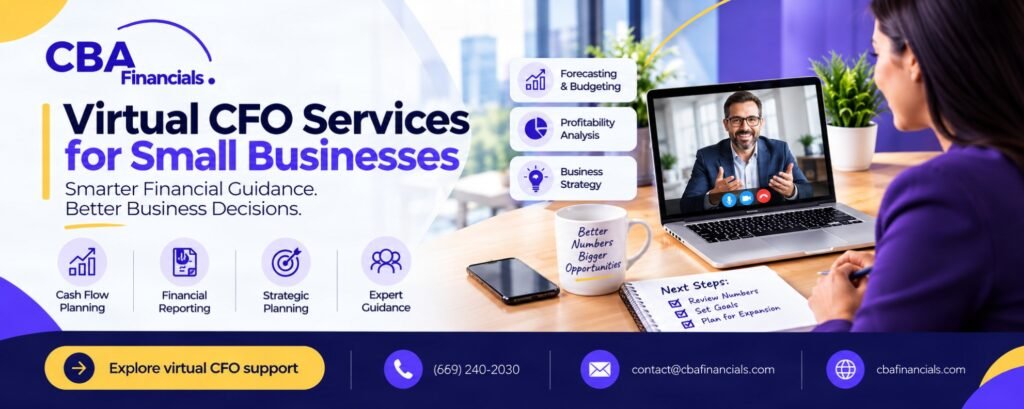
WHAT ARE VIRTUAL CFO SERVICES
Virtual CFO services provide CFO level financial support through a remote working relationship.
The CFO may review your financial statements, build forecasts, monitor cash flow, help with budgets and discuss important financial decisions with you.
The work can include
- Cash flow forecasting
- Budgeting and financial planning
- Financial reporting
- Profitability analysis
- KPI reporting
- Financial modeling
- Pricing analysis
- Hiring and spending decisions
- Financing support
- Growth planning
- Business performance reviews
The exact services depend on the provider and your business needs.
A virtual CFO should not simply send you financial reports and leave you to figure them out.
The purpose is to help you understand the numbers and use them when making business decisions.
Not sure what level of CFO support your business actually needs? Talk with CBA Financials about your cash flow, reporting, forecasting, and decision-support needs.
Explore CFO ServicesHOW A VIRTUAL CFO IS DIFFERENT FROM A BOOKKEEPER
A bookkeeper and a CFO have different responsibilities.
Bookkeeping focuses mainly on recording and organizing financial transactions.
A CFO looks more closely at what the numbers mean and what may happen next.
For example, a bookkeeper may record your sales and expenses for the month.
A CFO may use those numbers to answer questions such as
- Are our margins improving?
- Can we afford another employee?
- How much cash will we have three months from now?
- Which services are most profitable?
- Should we increase our prices?
- Can we afford a new location?
- Should we take on additional debt?
Both roles can be important.
Good financial records are also important because they help a business prepare financial statements and monitor its progress.
WHAT SHOULD VIRTUAL CFO SERVICES INCLUDE
There is no single package that every business need.
However, there are several core areas that a small business should consider when comparing providers.
Cash Flow Forecasting
Cash flow is one of the most important areas for a small business.
A company can be profitable on paper and still have difficulty paying its bills if cash comes in later than expected.
A virtual CFO can help create a cash flow forecast that shows expected money coming in and going out.
This can help you prepare for
- Payroll
- Tax payments
- Large purchases
- Loan payments
- Slow sales periods
- New hires
- Expansion costs
Cash flow forecasting is commonly included in virtual CFO services, along with budgeting, KPI tracking and financial reporting.
Budgeting and Forecasting
A budget gives your business a plan for expected income and expenses.
A forecast helps you compare that plan with what is actually happening.
A virtual CFO can review your budget and update forecasts when your business changes.
For example, if sales are lower than expected, the CFO can help you understand what that may mean for future cash flow.
If sales are growing faster than expected, the CFO can help you consider whether additional employees, equipment or working capital will be needed.
The goal is not to predict every number perfectly.
The goal is to give you a better view of what may happen next.
Monthly Financial Reporting
Financial reports are useful when they help you understand the business.
A virtual CFO may review
- Profit and loss statements
- Balance sheets
- Cash flow information
- Budget compared with actual results
- Key performance indicators
- Profit margins
- Accounts receivable
- Accounts payable
A CFO should also explain important changes rather than simply giving you a report.
Profitability and Margin Analysis
Revenue alone does not tell you whether the business is making enough money.
You may have products or services that generate strong sales but produce weak margins.
A virtual CFO can review revenue and costs to help identify where the business is making money and where costs may be too high.
This can be especially useful when deciding whether to
- Change pricing
- Drop an unprofitable service
- Hire additional staff
- Increase marketing spending
- Change suppliers
- Expand a profitable service
Small businesses often have limited resources.
Understanding which parts of the business are actually profitable can help owners make better use of those resources.
KPI Tracking
Key performance indicators can help you monitor important parts of the business.
The right KPIs depend on your industry.
A service business may track
- Revenue
- Gross margin
- Labor costs
- Client retention
- Revenue per employee
A retail business may focus more on
- Sales
- Gross margin
- Inventory
- Average transaction value
- Inventory turnover
A CFO can help you decide which numbers deserve regular attention.
The goal should not be to create a large list of numbers.
It should be to track the numbers that help you make decisions.
Financial Modeling
Financial modeling can help you understand the possible results of a business decision before you make it.
For example, you may want to know what happens if you
- Hire three employees
- Raise prices
- Open another location
- Purchase new equipment
- Take out a business loan
- Lose a major customer
- Increase marketing spending
A CFO can build different scenarios and show how each option could affect revenue, expenses and cash flow.
This gives you more information before making a major decision.
Support with Business Decisions
This is one of the areas that can separate CFO support from basic accounting work.
A virtual CFO can help you look at the financial side of decisions such as hiring, pricing, expansion and financing.
For example, before hiring another employee, you may want to know how much additional revenue the business needs to cover the employee cost.
Before opening another location, you may want to estimate startup costs, monthly expenses and expected sales.
Before increasing marketing spending, you may want to understand the expected return and the effect on cash flow.
The CFO does not make every decision for the owner.
The CFO provides financial information that can help the owner make the decision.
WHO SHOULD CONSIDER VIRTUAL CFO SERVICES
Virtual CFO services for small businesses can be useful for companies that have outgrown basic bookkeeping but do not need or cannot justify a full time CFO.
You may want to consider virtual CFO support if
- Your business is growing quickly
- Cash flow is becoming harder to manage
- You are making decisions without reliable forecasts
- You do not have a clear monthly financial review
- You are unsure which services are profitable
- You are preparing for expansion
- You are considering financing
- You are hiring more employees
- Your financial reports are difficult to understand
- You want regular financial guidance without hiring a full time CFO
Current virtual CFO providers commonly position their services for established and growing small businesses that need help with cash flow, margins, budgeting, forecasting and long-term planning.
WHEN A VIRTUAL CFO MAY NOT BE NECESSARY
Not every small business needs CFO support.
If your business is very small, financial activity is simple and your existing accountant or bookkeeper already provides the planning support you need, adding a CFO may not be necessary.
You should also make sure your basic accounting records are in good shape first.
A CFO cannot make reliable decisions from incomplete or inaccurate financial information.
VIRTUAL CFO SERVICES VS FULL TIME CFO
A full time CFO works inside the company and normally has a broader ongoing responsibility for the finance function.
A virtual CFO provides similar types of financial guidance through an external arrangement.
For many small businesses, the main difference is the level of commitment.
A full time CFO may make sense when the company has a large finance function and needs daily senior financial leadership.
A virtual CFO may make more sense when the company needs experienced financial guidance but does not need a CFO working full time.
The right choice depends on the complexity and needs of the business.
VIRTUAL CFO SERVICES VS OUTSOURCED CFO SERVICES
The terms can overlap.
A virtual CFO usually emphasizes remote delivery.
An Outsourced CFO Services means the CFO role is handled by an outside provider rather than a full-time employee.
Some firms use both terms for similar services.
When comparing providers, focus less on the label and more on what you actually receive.
Ask what the provider will do each month.
Ask how often you will meet.
Ask what reports you will receive.
Ask whether cash flow forecasting is included.
Ask who will be your main contact.
Ask what happens when you need help with an important financial decision.
HOW OFTEN SHOULD YOU MEET WITH A VIRTUAL CFO
The right schedule depends on your business.
Some businesses may need weekly financial discussions during a period of rapid growth or financial pressure.
Others may need a structured monthly review.
A monthly CFO meeting may cover
- Financial results
- Cash position
- Budget compared with actual results
- Upcoming expenses
- Profitability
- KPIs
- Hiring plans
- Growth plans
- Important decisions
The schedule should match the pace of your business.
WHAT A SIMPLE VIRTUAL CFO PROCESS CAN LOOK LIKE
A practical process does not have to be complicated.
Step One
Review the accounting records and current financial reports.
Step Two
Identify the biggest financial issues facing the business.
Step Three
Build or update the cash flow forecast.
Step Four
Review the budget and expected results.
Step Five
Discuss important business decisions.
Step Six
Agree on the financial actions that need to happen next.
Step Seven
Review the results during the next meeting.
This creates a regular financial process instead of waiting until a problem appears.
HOW TO CHOOSE VIRTUAL CFO SERVICES
Before hiring a provider, look beyond the monthly price.
Consider the provider's experience, communication process, reporting and actual service scope.
Ask these questions
- What businesses do you normally work with?
- What will you handle each month?
- Will you prepare cash flow forecasts?
- How often will we meet?
- What financial reports will I receive?
- Will you explain the reports with me?
- Can you help with budgeting?
- Can you build financial models?
- Can you work with my current accountant or bookkeeper?
- Who will I contact when I have an urgent question?
- What services are included in the monthly fee?
- Are special projects charged separately?
Clear answers can help you compare providers more fairly.
Comparing virtual CFO providers? Review the deliverables, meeting schedule, reporting, and financial support your business needs with CBA Financials.
Book a ConsultationWHAT OTHER VIRTUAL CFO GUIDES OFTEN MISS
Many service pages list CFO features but do not explain how those services fit into the daily life of a small business.
A small business owner usually does not need another complicated financial system.
They need answers to practical questions.
- How much cash will we have next month?
- Can we afford this hire?
- Which service is making the most money?
- Why did profit change this month?
- Can we afford to expand?
- Are our expenses growing too quickly?
- What happens if sales fall for three months?
A good virtual CFO service should connect financial reports with these real business questions.
That is an important difference between simply receiving financial information and having someone help you understand it.
QUESTIONS TO ASK BEFORE HIRING A VIRTUAL CFO
Before you make a decision, ask
- 1. What type of small businesses do you work with?
- 2. What will you deliver each month?
- 3. Do you provide cash flow forecasting?
- 4. Do you help with budgeting and forecasting?
- 5. Will you review profitability?
- 6. Which KPIs will you track?
- 7. How often will we meet?
- 8. Who will be my CFO?
- 9. Can you work with my current accounting team?
- 10. Can you help with major business decisions?
- 11. What is included in the monthly service?
- 12. Are there additional fees for special projects?
The answers should make it clear what you are paying for.
WHAT GOOD VIRTUAL CFO SUPPORT SHOULD GIVE YOU
A good virtual CFO relationship should help you understand your business finances more clearly.
You should know
- Where your cash stands
- What your business may need in the coming months
- Which areas are profitable
- Where costs are increasing
- Whether you are on track with your budget
- What major financial decisions could mean for the business
The goal is not to create more reports.
The goal is to make the financial information you already have more useful.
FINAL THOUGHTS
Virtual CFO services for small businesses can provide financial guidance without the commitment of hiring a full time CFO.
The right service can help with cash flow forecasting, budgeting, financial reporting, profitability, KPIs and important business decisions.
But not every virtual CFO service is the same.
Before choosing a provider, look carefully at the actual deliverables, meeting schedule, communication process, financial experience and pricing.
Make sure the provider can work with your existing accounting records and understands the type of decisions your business needs to make.
The best CFO support should make your financial information easier to understand and more useful when you are deciding what to do next.
EXPLORE VIRTUAL CFO SUPPORT
If your business needs stronger financial planning, clearer reporting or regular CFO level guidance, Explore virtual CFO support and find out what level of help fits your business.
