
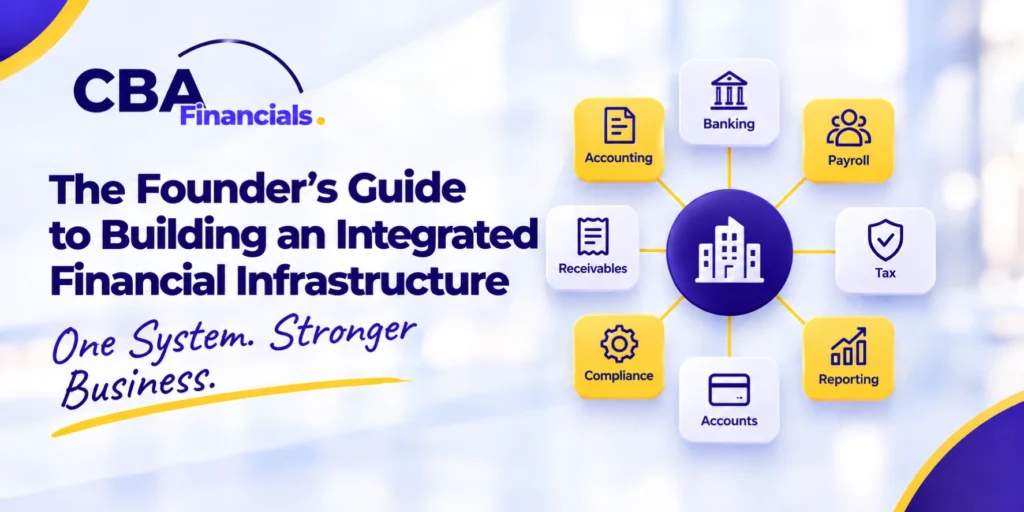
WHAT IS AN INTEGRATED FINANCIAL INFRASTRUCTURE
An integrated financial infrastructure is the financial foundation that supports how a business is created, operated, monitored, and planned.
It can include
- Business entity formation
- Business banking
- Accounting and bookkeeping
- Payroll
- Accounts payable
- Accounts receivable
- Expense management
- Cash flow tracking
- Financial reporting
- Tax planning
- Tax filing
- Compliance
- Budgeting
- Forecasting
- Financial advisory
The goal is not simply to have every financial service under one roof.
The real goal is to make sure these areas work together.
For example, the way a company is structured can affect its tax responsibilities. The way expenses are recorded affects financial reporting. Financial reports can influence cash flow decisions. Payroll affects both cash planning and tax compliance.
When these areas are connected, financial information becomes more useful.
WHY FOUNDERS NEED A CONNECTED FINANCIAL SYSTEM
Founders often spend most of their time on sales, customers, hiring, operations, and growth.
Finance can become something they handle only when a problem appears.
That creates a reactive cycle.
A tax deadline arrives and records need to be cleaned up. Cash becomes tight and the founder starts reviewing bank transactions. An investor asks for financial reports and the business has to gather information from several sources. A lender requests documents and the company discovers that its records are incomplete.
A connected financial infrastructure reduces these situations.
It gives the founder a clearer picture of what is happening throughout the year rather than only during tax season.
This becomes increasingly important as the business grows.
START WITH THE RIGHT BUSINESS STRUCTURE
The financial infrastructure begins before the first major transaction.
Choosing the right business entity can affect taxes, ownership, liability, reporting, and future growth.
Common structures include sole proprietorships, partnerships, limited liability companies, and corporations.
The right choice depends on the business and its goals.
Founders should consider factors such as
- Ownership structure
- Number of owners
- Expected revenue
- Tax considerations
- Liability protection
- Plans for raising capital
- Hiring plans
- Long term growth
Entity formation should not be treated as an isolated legal task.
It should be considered alongside the company's accounting and tax strategy.
This is where the concept of entity formation to tax filing becomes important. The decisions made when a business is formed can influence how financial records are maintained and how tax obligations are handled later.
BUILD SEPARATE BUSINESS FINANCIAL ACCOUNTS
Once the business is established, financial separation becomes critical.
Business income should flow through business accounts. Business expenses should be paid from business accounts whenever possible.
Mixing personal and business transactions can make accounting more difficult and create unnecessary confusion.
A clean financial structure usually includes
- Dedicated business checking accounts
- Business savings accounts
- Business credit cards
- Clear expense policies
- Organized payment systems
- Proper transaction documentation
This creates a cleaner foundation for bookkeeping and reporting.
It also makes it easier for the founder to understand how much money the business actually has available.
MAKE BOOKKEEPING THE FOUNDATION
Bookkeeping is more than recording transactions for tax purposes.
It creates the financial history of the business.
Accurate bookkeeping helps answer important questions.
How much revenue did the company generate?
Where did the money go?
Which expenses are increasing?
How much cash is available?
Which customers still owe money?
Is the business becoming more profitable?
Without reliable records, these questions become difficult to answer.
Struggling to get reliable monthly financial records? CBA Financials can help establish a consistent bookkeeping process.
Improve Your BookkeepingAn effective bookkeeping system should be maintained throughout the year rather than rebuilt shortly before tax filing.
CONNECT PAYROLL WITH ACCOUNTING
Payroll is another area that should connect directly with the broader financial system.
Payroll affects cash flow, financial statements, tax reporting, employee records, and compliance.
When payroll information is disconnected from accounting, errors can occur.
A connected process helps ensure that payroll expenses, taxes, benefits, and related transactions are reflected properly in the company's books.
Founders should also monitor payroll closely as the business grows.
Outsourcing payroll does not mean ignoring it.
Business owners should still review payroll totals, employee changes, tax payments, and unusual activity.
CREATE A RELIABLE ACCOUNTS RECEIVABLE PROCESS
Revenue is important, but revenue does not always mean cash has been collected.
A company can have strong sales and still experience cash flow pressure when customers take too long to pay.
An integrated financial infrastructure should connect invoicing with accounts receivable and cash flow monitoring.
Founders should know
- What has been invoiced
- What has been collected
- What is overdue
- Which customers regularly pay late
- How much cash is expected in the coming weeks
Clear payment terms, timely invoicing, payment reminders, and consistent collection processes can improve cash flow without requiring more sales.
KEEP ACCOUNTS PAYABLE UNDER CONTROL
The other side of cash flow is what the business owes.
Accounts payable should be organized so the company knows which bills are due, when they are due, and which payments should be prioritized.
A good process can help prevent
- Missed payments
- Duplicate payments
- Late fees
- Cash flow surprises
- Vendor disputes
Founders should avoid paying every bill as soon as it arrives without considering the company's overall cash position.
The objective is not to delay legitimate payments.
The objective is to manage payment timing responsibly while maintaining strong vendor relationships.
BUILD FINANCIAL REPORTING AROUND DECISIONS
Financial reports should help founders make decisions.
A basic reporting system may include
- Profit and loss statements
- Balance sheets
- Cash flow reports
- Accounts receivable aging
- Accounts payable aging
- Budget comparisons
- Monthly financial summaries
These reports become much more valuable when reviewed consistently.
A founder should be able to look at the numbers and understand what changed, why it changed, and what action may be needed.
Financial reporting should not become a collection of spreadsheets that nobody uses.
Turn financial reports into useful decisions with structured reporting and CFO guidance.
Discuss CFO SupportIt should become part of the operating rhythm of the company.
MAKE TAX PLANNING PART OF THE YEAR
Tax preparation is important, but tax planning should happen before the tax return is prepared.
Waiting until filing season can limit the options available to the business.
Throughout the year, founders should monitor areas such as
- Estimated tax payments
- Business deductions
- Payroll taxes
- Depreciation
- Owner compensation
- Entity structure
- State tax obligations
- Changes in business activity
A connected system makes tax planning easier because the tax professional has access to better financial information.
This is another reason entity formation to tax filing should be viewed as one financial journey rather than separate tasks.
USE TECHNOLOGY WITHOUT LOSING FINANCIAL OVERSIGHT
Modern businesses have access to many financial tools.
Accounting platforms can automate transaction recording. Payment systems can simplify collections. Payroll software can process employee payments. Expense platforms can organize receipts. Reporting tools can provide financial dashboards.
Technology can reduce manual work.
But adding more software does not automatically create a better financial system.
Too many disconnected platforms can actually make financial management harder.
Founders should focus on whether their tools communicate effectively and whether the information they produce is accurate.
The goal is a simple and connected technology stack.
THINK ABOUT ALL IN ONE BUSINESS FINANCE
The idea of all in one business finance is becoming more important as companies look for simpler ways to manage their financial operations.
But all in one should not mean that every service has to be handled by the same software.
Instead, it should mean that the financial system feels connected from the founder's perspective.
The founder should not have to manually reconcile information from five different places just to understand the company's financial position.
Bring bookkeeping, payroll, tax and reporting into a more coordinated financial process.
Request a Financial ReviewA well-designed system connects the major financial functions and creates a consistent flow of information.
BUILD A CASH FLOW FORECAST
Profit and cash are not the same thing.
A company can report a profit while still struggling to pay its bills.
Cash flow forecasting helps founders anticipate this difference.
A basic forecast can track
- Expected customer collections
- Payroll
- Vendor payments
- Taxes
- Loan payments
- Major purchases
- Recurring expenses
- Planned investments
Looking ahead by several weeks or months can give founders more time to respond when cash pressure is coming.
That is much better than discovering a cash shortage after it happens.
CREATE A FINANCIAL REVIEW ROUTINE
An integrated financial infrastructure needs regular attention.
Founders do not necessarily need to spend hours every day reviewing financial information.
A simple routine can be enough.
Weekly review
Review cash balances, major transactions, incoming payments, and upcoming expenses.
Monthly review
Review financial statements, profitability, cash flow, receivables, payables, and budget performance.
Quarterly review
Look at tax planning, financial trends, forecasts, business goals, and major strategic decisions.
Annual review
Review the overall financial structure, tax strategy, entity structure, technology, reporting process, and plans for the next year.
This creates consistency.
WATCH FOR FINANCIAL WARNING SIGNS
A good financial infrastructure should make problems easier to identify.
Founders should pay attention when
- Revenue is growing but cash is declining
- Customers are taking longer to pay
- Expenses are increasing faster than revenue
- Payroll is putting pressure on cash flow
- Tax payments are becoming difficult to manage
- Financial reports are consistently delayed
- Bookkeeping requires frequent cleanup
- Business and personal transactions are mixed
- The founder cannot explain major changes in financial results
These signals do not always mean something is seriously wrong.
They do mean the business deserves a closer look.
AVOID BUILDING FINANCE AROUND THE FOUNDER ALONE
Many small businesses depend too heavily on the founder for financial decisions.
The founder approves payments, reviews every invoice, manages tax information, communicates with the bookkeeper, checks payroll, and tries to understand financial reports.
That may work in the early stage.
It becomes difficult to maintain as the company grows.
A strong financial infrastructure creates documented processes and clear responsibilities.
The business should continue functioning even when the founder is focused on customers, hiring, or growth.
WHEN PROFESSIONAL FINANCIAL ADVISORY BECOMES VALUABLE
There comes a point when founders need more than bookkeeping or tax preparation.
They need help connecting the numbers to business decisions.
Financial advisory can help with questions such as
- Can we afford to hire another employee?
- Should we increase prices?
- Is the business generating enough cash to expand?
- Should we purchase equipment?
- How much should we keep in reserves?
- Are our margins improving?
- What should we expect over the next six months?
- Is our current financial structure ready for growth?
This is where CBA Financials advisory can provide value.
The objective is not simply to produce reports.
It is to help founders understand the financial story behind the business and use that information to make better decisions.
HOW TO BUILD YOUR FINANCIAL INFRASTRUCTURE STEP BY STEP
Founders do not need to rebuild everything at once.
A practical approach is to start with the foundation.
Step 1
Review the current business structure and financial accounts.
Step 2
Separate personal and business finances.
Step 3
Create a reliable bookkeeping process.
Step 4
Connect payroll, invoicing, expenses, and accounting.
Step 5
Establish monthly financial reporting.
Step 6
Create a tax planning process instead of waiting for tax season.
Step 7
Build a cash flow forecast.
Step 8
Document recurring financial responsibilities.
Step 9
Review the financial system regularly.
Step 10
Add professional advisory support as the business becomes more complex.
This approach allows the financial infrastructure to grow with the company.
THE GOAL IS BETTER FINANCIAL VISIBILITY
An integrated financial infrastructure is not about creating more complexity.
It is about removing unnecessary complexity.
Founders need to know where their business stands financially without spending hours collecting information from different sources.
When formation, banking, bookkeeping, payroll, reporting, tax, cash flow, and advisory services work together, the business gains a stronger financial foundation.
The result is better visibility and better preparation for growth.
FINAL THOUGHTS
Your company's financial infrastructure should grow alongside your business.
From entity formation to tax filing, every financial decision can contribute to the quality of the system you build.
The right structure can make bookkeeping easier. Clean records can improve reporting. Better reporting can improve decisions. Better decisions can strengthen cash flow and support sustainable growth.
For founders looking for all in one business finance, the goal should not simply be convenience.
The goal should be a financial system that gives you clarity, control, and confidence.
CBA Financials can help connect the financial pieces of your business and provide practical guidance as your company grows.
If your current financial processes feel disconnected, it may be time to build a system that works as one.
Discuss your current finance processes and the next steps for a more integrated financial foundation.
Schedule a Financial Review