
WHAT IS TAX PREPARATION OUTSOURCING?
Tax preparation outsourcing means using an outside tax professional or accounting service to handle agreed parts of your tax preparation work.
Depending on the arrangement, the provider may help with
- Collecting tax documents
- Organizing financial information
- Reviewing accounting records
- Preparing tax returns
- Preparing supporting schedules
- Identifying missing information
- Reviewing completed returns
- Coordinating final filing
The level of support depends on the service agreement.
Some businesses outsource only the preparation work. Others use a provider for most of the process while keeping final approval and other responsibilities with their internal team.
WHY BUSINESSES OUTSOURCE TAX PREPARATION
Tax preparation can become difficult to manage when a business is growing.
A business may have more transactions, more employees, more contractors, multiple locations, or several entities to report.
At the same time, the owner and internal accounting team still have daily responsibilities.
Outsourcing can provide extra preparation capacity without requiring the business to hire a full-time tax employee.
Businesses may consider outsourcing when
- Tax preparation takes too much staff time
- Internal accounting staff are already busy
- Tax season creates a temporary workload increase
- The business has multiple tax returns
- Records require additional review
- The company needs tax preparation experience
- Filing deadlines are becoming harder to manage
The goal is to create a smoother process while keeping the business informed and involved.
Tax preparation taking too much time from your team? Talk with CBA Financials about building a more organized outsourced tax preparation process.
Discuss Tax Preparation SupportTHE TAX PREPARATION OUTSOURCING PROCESS
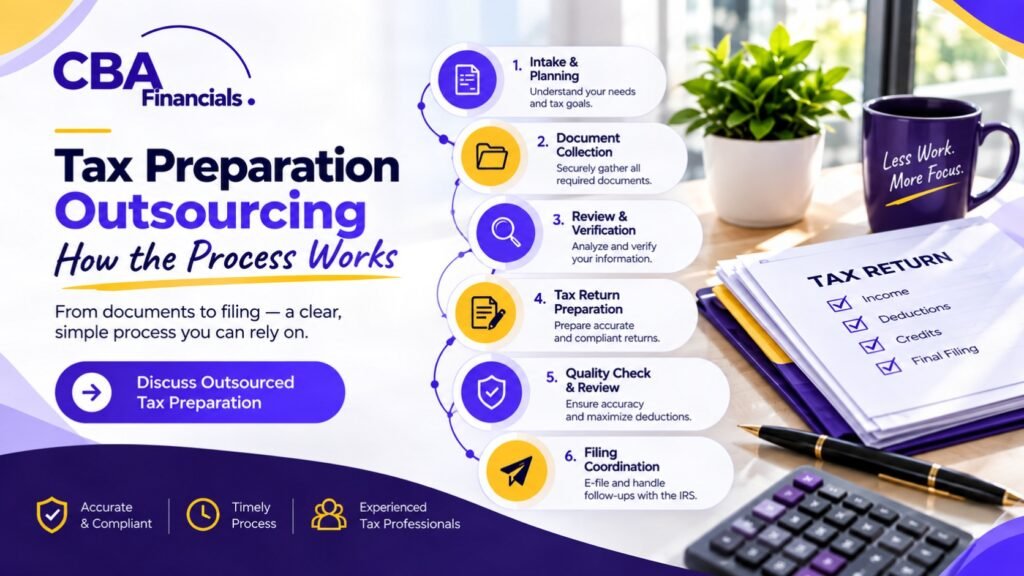
A well-organized outsourcing process usually follows several stages.
Each stage has a specific purpose.
Step One: Initial Intake
The first step is understanding the business.
The tax preparation provider may ask for information about your company, its activities, ownership, accounting system, and previous tax filings.
You may be asked about
- Business structure
- Ownership
- Business locations
- Main business activities
- Employees
- Independent contractors
- Previous tax returns
- Changes during the year
- Major purchases
- Business loans
- New investments
- Property sales
This conversation gives the provider a starting point.
It also helps determine which documents will be needed.
A tax professional should understand your business instead of preparing a return based only on numbers in an accounting system.
The IRS advises taxpayers to choose paid tax preparers carefully and to ask about their qualifications, fees, and availability after the return is filed.
Step Two: Creating a Document List
After the initial intake, the provider can identify the records needed for preparation.
The list will depend on your business and tax situation.
Common documents include
- Prior year tax returns
- Profit and loss statement
- Balance sheet
- Bank statements
- Credit card statements
- Sales records
- Expense records
- Payroll reports
- Contractor information
- Asset purchase records
- Loan statements
- Estimated tax payment records
- Other tax forms
Providing the documents in an organized way can help reduce delays.
The IRS recommends keeping records that support income, deductions, credits, and other information reported on tax returns.
Step Three: Secure Document Collection
The next step is getting the records to the tax preparation team.
A provider may use a secure client portal or another method for collecting documents.
This stage should be simple for the business.
You should know
- What documents are required
- Where documents should be uploaded
- Who can access the information
- How missing documents are requested
- How questions will be communicated
Tax records contain sensitive financial information, so businesses should understand how their documents are handled before sending them to an outside provider.
Step Four: Reviewing the Records
The provider reviews the information before preparing the return.
This step is important because the tax preparer needs to understand what the numbers represent.
The review may include
- Checking income records
- Reviewing expenses
- Checking bank reconciliations
- Reviewing credit card activity
- Checking asset purchases
- Reviewing loan information
- Comparing current records with previous years
- Looking for missing information
- Identifying unusual transactions
If something does not make sense, the provider can ask about it before continuing.
This can prevent unnecessary corrections later.
Step Five: Checking the Books
The quality of the accounting records can affect how smoothly tax preparation goes.
If the books are current and accounts are reconciled, the tax preparer has a better starting point.
If there are many uncategorized transactions or unreconciled accounts, additional bookkeeping work may be needed first.
For example, the provider may discover that
- Bank accounts have not been reconciled
- Credit card transactions are missing
- Personal and business transactions are mixed
- Business expenses have not been categorized
- Asset purchases are recorded incorrectly
- Loan balances do not agree with statements
These issues may need to be addressed before the return can be prepared accurately.
The IRS explains that business records should clearly show income and expenses and support the information reported on a tax return.
Step Six: Preparing the Tax Return
Once the information is ready, the tax preparation team begins preparing the return.
The work may include
- Entering financial information
- Preparing applicable tax forms
- Preparing supporting schedules
- Reviewing income
- Reviewing business expenses
- Applying applicable deductions
- Preparing federal returns
- Preparing state returns
The preparation process will depend on the business structure.
A sole proprietor, partnership, S corporation, and C corporation can have different filing requirements.
That is why the provider needs complete information about the business before beginning the preparation work.
Step Seven: Resolving Questions
Questions often come up during preparation.
For example, a tax professional may need more information about a large purchase or a transaction that was recorded in an unusual way.
They may ask
- Was this purchase for business use?
- When was the asset purchased?
- Was the business property sold?
- Was this payment made to an employee or contractor?
- Did the company operate in another state?
- Was this loan used for business purposes?
These questions are part of the review process.
Providing answers and supporting documents quickly can help prevent delays.
Step Eight: Tax Return Review
After the initial preparation is complete, the return should be reviewed.
The review may look at
- Business income
- Major expenses
- Tax forms
- Supporting schedules
- Business information
- Prior year information
- State filing information
- Unusual changes
The purpose is to catch issues before the return is finalized.
A clear review process is an important part of tax preparation outsourcing services.
Businesses should ask whether the provider has a review process and who is responsible for that review.
Step Nine: Client Review
The business should have an opportunity to review the completed return.
You do not need to be a tax expert to perform a basic review.
Start with the information you know.
- Check the business name.
- Check the income.
- Check major expenses.
- Check ownership information.
- Check estimated tax payments.
- Check major purchases and other important transactions.
If something does not look right, ask your tax professional before approving the return.
The IRS states that taxpayers remain responsible for the information reported on their tax returns even when a paid preparer prepares the return.
Step Ten: Making Corrections
If the review identifies a problem, the return can be corrected before filing.
The provider may need
- Additional documents
- Clarification about a transaction
- Updated financial information
- Corrected business information
- Additional state information
The sooner these issues are identified, the easier it is to address them.
This is another reason why businesses should avoid waiting until the last possible moment to begin tax preparation.
Step Eleven: Final Approval
Once the return has been reviewed and necessary changes have been made, the business can provide final approval.
Before approving the return, make sure you understand
- What returns are being filed
- Which states are included
- Whether all important business information is included
- What tax amount is due or expected
- Whether additional action is required
- Who will handle the filing
A clear approval process helps avoid confusion about responsibility.
Step Twelve: Filing Coordination
The final stage is filing.
Depending on the agreement, the outsourced provider may handle filing coordination or prepare the completed return for another professional to submit.
The process may include
- Final approval
- Electronic authorization
- Federal filing
- State filing
- Filing confirmation
- Payment instructions
- Final document delivery
Electronic filing requirements can vary depending on the type of return and filing method. The IRS provides specific guidance for electronic filing and authorization requirements.
Before the engagement starts, make sure it is clear who is responsible for submitting the final return.
WHAT YOUR BUSINESS NEEDS TO PROVIDE
Outsourcing does not remove the need for accurate information from the business.
You may need to provide
- Complete financial statements
- Income records
- Expense records
- Bank statements
- Credit card statements
- Payroll records
- Contractor records
- Asset information
- Loan information
- Prior tax returns
- Estimated tax payment information
- Details about major business changes
The more complete the information is, the easier it can be for the provider to move through the preparation process.
WHAT THE OUTSOURCED PROVIDER MAY HANDLE
The exact responsibilities depend on the agreement.
A provider may handle
- Document review
- Tax data preparation
- Tax return preparation
- Supporting schedules
- Federal returns
- State returns
- Preparation review
- Follow up questions
- Corrections
- Filing coordination
Always ask for a clear description of the services before signing an agreement.
Not sure what should be included in outsourced tax preparation? CBA Financials can help you review the scope, responsibilities, and filing process before work begins.
Review the Service ScopeDo not assume that every provider includes the same work.
TAX PREPARATION OUTSOURCING DOES NOT ALWAYS INCLUDE TAX PLANNING
Tax preparation and tax planning are different.
Tax preparation generally focuses on preparing the return for a completed tax year.
Tax planning looks ahead and focuses on decisions that may affect future tax obligations.
For example, a business may want to discuss
- Estimated tax payments
- Planned equipment purchases
- Business structure
- Retirement contributions
- Owner compensation
- Timing of income and expenses
If you need planning support, ask whether it is included in the service.
WHAT HAPPENS IF YOUR BOOKS NEED CLEANUP
Sometimes a business wants to outsource tax preparation but discovers that its bookkeeping is not ready.
This does not necessarily mean the tax preparation process has to stop.
First, identify the problems.
Review unreconciled accounts.
Find missing transactions.
Categorize expenses.
Separate personal and business activity.
Update loan balances.
Record asset purchases.
Then determine whether bookkeeping cleanup should be completed before tax preparation.
Some accounting providers offer both bookkeeping and tax services, while others focus only on tax preparation.
Ask about this before choosing a provider.
HOW COMMUNICATION WORKS DURING OUTSOURCING?
Communication can make a major difference in the outsourcing experience.
Before work begins, establish
- Main contact person
- Preferred communication method
- Document submission method
- Expected response times
- Question and answer process
- Review process
- Filing confirmation process
You should know who to contact when you have a question.
You should also know who will contact you when the provider needs additional information.
HOW LONG DOES THE PROCESS TAKE?
There is no fixed timeline for every business.
Preparation time can depend on
- Business structure
- Number of tax returns
- Number of states
- Business size
- Record quality
- Number of transactions
- Missing documents
- Bookkeeping cleanup
- Complexity of the return
A business with organized records may move through the process more quickly than a business that needs significant record cleanup.
Ask the provider for an expected timeline based on your specific situation.
HOW MUCH DO TAX PREPARATION OUTSOURCING SERVICES COST?
Pricing varies from one provider to another.
The cost may depend on
- Type of business
- Type of tax return
- Number of returns
- Number of states
- Number of owners
- Tax return complexity
- Bookkeeping condition
- Additional schedules
- Tax planning needs
- Review requirements
Do not compare prices without comparing the services included.
One provider may include state returns and review while another may charge separately for those services.
Ask for the scope of work and pricing in writing.
HOW TO CHOOSE AN OUTSOURCED TAX PREPARATION PROVIDER?
Before choosing a provider, look beyond the price.
Ask about the actual process.
Important questions include
- Who prepares the return
- Who reviews the return
- What type of businesses do you work with
- What documents will you need
- How are documents collected
- How are sensitive records protected
- How are questions handled
- What is included in the fee
- Are state returns included
- Is tax planning included
- Who handles final filing
- What support is available after filing
The IRS recommends checking the credentials of a paid tax preparer and making sure the preparer has a valid PTIN.
A SIMPLE OUTSOURCING TAX PREPARATION CHECKLIST
Before the process begins, gather the following
- Previous tax returns
- Profit and loss statement
- Balance sheet
- Bank statements
- Credit card statements
- Sales records
- Expense records
- Payroll records
- Contractor records
- Asset purchase records
- Loan statements
- Estimated tax payments
- Business ownership information
- Details of major business changes
- State tax information
- Questions for your tax professional
Having these records ready can help reduce unnecessary back and forth.
COMMON PROBLEMS TO AVOID
A few simple problems can make outsourced tax preparation harder than it needs to be.
Starting too late
Late preparation leaves less time to find missing information.
Sending incomplete records
Incomplete records often lead to repeated requests and delays.
Not explaining major changes
Your provider should know about major business events that occurred during the year.
Assuming everything is included
Always confirm whether bookkeeping cleanup, state returns, tax planning, and filing are included.
Not reviewing the final return
Even when a professional prepares your return, you should review the completed information before approval.
Not knowing who handles filing
Make sure there is no confusion about who is responsible for final submission.
BENEFITS OF A CLEAR OUTSOURCING PROCESS
A clear process can make tax preparation easier to manage.
It gives the business a defined list of responsibilities.
It gives the provider the information needed to complete the work.
It also makes it easier to identify missing documents and unanswered questions.
Instead of waiting until the end of the process to discover problems, both sides can address them as the work moves forward.
That can make the overall tax preparation experience more organized.
IS TAX PREPARATION OUTSOURCING RIGHT FOR YOUR BUSINESS?
Outsourcing may be worth considering if your internal team spends too much time preparing tax records or if you do not have enough tax preparation capacity.
It may also make sense when your business has grown and tax preparation has become more involved.
The decision should depend on your workload, internal resources, recordkeeping, tax needs, and the level of support you want.
If tax season is stretching your internal team, CBA Financials can help you identify which parts of the preparation process could be handled externally.
Discuss Outsourcing OptionsThe first step is understanding what is currently taking the most time.
From there, you can decide which parts of the process should remain internal and which parts could be handled by an outside provider.
FINAL THOUGHTS
Tax preparation outsourcing can provide businesses with additional support during a demanding part of the year.
The process should start with a clear intake.
The required documents are then collected.
Financial records are reviewed.
The tax return is prepared.
Questions are answered.
The completed return is reviewed.
Corrections are made when necessary.
The business provides final approval.
The return is then prepared for filing or filing is coordinated according to the engagement.
The most important thing is to understand the process before you outsource.
Know what you need to provide.
Know what the provider will handle.
Know who reviews the return.
Know who coordinates filing.
And know what support is available after the return has been completed.
If your current tax preparation process is taking too much time, professional outsourcing support may give your business a more organized way to handle the work.
DISCUSS OUTSOURCED TAX PREPARATION
CBA Financials can review your current tax preparation needs and explain how outsourced tax preparation support can fit into your business workflow.
Discuss outsourced tax preparation with CBA Financials today.
FREQUENTLY ASKED QUESTIONS
What is tax preparation outsourcing?
Tax preparation outsourcing is the use of an outside tax professional or accounting team to handle agreed parts of the tax return preparation process.
How does outsourcing tax preparation work?
The process usually starts with an initial intake followed by document collection, record review, tax return preparation, questions and corrections, final review, approval, and filing coordination.
What documents are needed for tax preparation outsourcing?
Common documents include financial statements, bank and credit card records, income and expense information, payroll records, contractor information, asset records, loan statements, previous tax returns, and estimated tax payment records.
Can small businesses use tax preparation outsourcing services?
Yes. Small businesses can use outsourced tax preparation when they need additional preparation capacity or professional support.
Does tax preparation outsourcing include bookkeeping?
Not always. Some providers offer bookkeeping and tax preparation together, while others only provide tax preparation. Ask about the scope of service before beginning.
Does outsourcing tax preparation include tax planning?
Not necessarily. Tax preparation and tax planning are separate services unless both are included in the engagement.
Who is responsible for the tax return after outsourcing?
The exact responsibilities depend on the engagement. The tax preparer handles the agreed preparation work, while the taxpayer remains responsible for reviewing the information and the return itself. The IRS states that taxpayers are responsible for the information reported on their returns.
When should a business start outsourcing tax preparation?
Starting early gives the business more time to collect records, resolve bookkeeping issues, answer questions, review the completed return, and address filing requirements before the applicable deadline.
