
Unsure how much to set aside for quarterly taxes? CBA Financials can help you review your income, deductions, and estimated payment strategy before the next deadline.
Review Your Estimated Tax PlanWHAT ARE QUARTERLY ESTIMATED TAX PAYMENTS?
Estimated tax is a way of paying federal taxes during the year when those taxes are not fully covered by withholding.
For a business owner, estimated payments can cover both income tax and self-employment tax.
The IRS generally expects taxpayers to pay tax as income is earned rather than waiting until the annual tax return is filed.
Estimated tax payments are commonly associated with:
- Sole proprietors
- Independent contractors
- Freelancers
- Single-member LLC owners
- Partners in partnerships
- S corporation shareholders
- Investors with significant taxable income
- Individuals with income that is not subject to sufficient withholding
Not every taxpayer needs to make estimated payments.
The requirement depends on the amount of tax you expect to owe and the amount already covered through withholding and credits.
WHO GENERALLY NEEDS TO PAY ESTIMATED TAXES?
For 2026, the IRS generally says you may need to make estimated tax payments if both of these conditions apply:
1. Expected Tax Due
You expect to owe at least $1,000 in tax after subtracting withholding and refundable credits.
2. Withholding and Credits
You expect your withholding and refundable credits to be less than the smaller of:
- 90% of the tax shown on your current-year return, or
- 100% of the tax shown on your prior-year return.
For certain higher-income taxpayers, the prior-year percentage increases to 110%. The prior-year return generally must cover a full 12 months.
These rules are important because they provide a way to plan payments without necessarily knowing your exact final tax liability months in advance.
WHAT IS THE ESTIMATED TAX SAFE HARBOR?
One of the most useful concepts for business owners is the safe harbor tax rules.
A safe harbor generally allows you to avoid an estimated tax underpayment penalty when you have prepaid enough tax under the applicable IRS rules, even if your actual tax liability ends up being higher.
For many taxpayers, the relevant benchmark is the smaller of:
- 90% of the current year's tax, or
- 100% of the previous year's tax.
For taxpayers whose prior-year adjusted gross income was more than $150,000, the prior-year safe-harbor percentage is generally 110%. For married taxpayers filing separately, the threshold is $75,000.
A Simple Example
Suppose your 2025 tax liability was $20,000.
If you qualify to use the 100% prior-year safe harbor, you could generally aim to have $20,000 covered through withholding and estimated payments during 2026.
If your 2026 tax liability eventually turns out to be $25,000, you may still avoid the estimated tax underpayment penalty if you otherwise meet the safe-harbor requirements.
You would still owe the remaining $5,000 when you file your 2026 return.
The safe harbor is therefore not a way to eliminate tax.
It is a payment-planning method that can help reduce the risk of an underpayment penalty.
HIGHER-INCOME TAXPAYERS HAVE A DIFFERENT PRIOR-YEAR THRESHOLD
Business owners with higher income need to pay particular attention to the prior-year safe harbor.
If your adjusted gross income for the previous year was more than $150,000, the prior-year benchmark generally becomes 110% instead of 100%.
For married individuals filing separately, the threshold is $75,000.
For example, if your previous-year tax was $30,000, a taxpayer subject to the 110% rule would generally need to have $33,000 covered through withholding and estimated payments to satisfy that prior-year safe harbor.
That is one reason business owners with growing income should review estimated payments rather than automatically repeating last year's payment amount.
WHEN ARE ESTIMATED TAX PAYMENTS DUE?
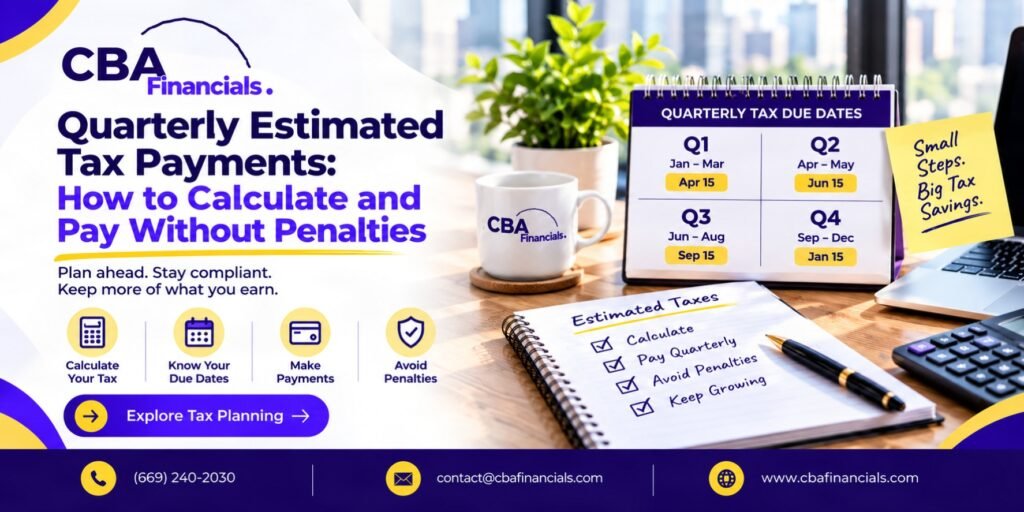
For calendar-year taxpayers, the standard estimated tax payment dates are:
| Payment Period | 2026 Due Date |
|---|---|
| January 1 through March 31 | April 15, 2026 |
| April 1 through May 31 | June 15, 2026 |
| June 1 through August 31 | September 15, 2026 |
| September 1 through December 31 | January 15, 2027 |
These periods are not equal three-month quarters.
The second payment period covers only two months, while the fourth covers four months.
The IRS also provides that if a payment deadline falls on a Saturday, Sunday, or legal holiday, the payment is generally due on the next business day.
As of the 2026 tax year, these are the applicable general federal estimated-tax dates for calendar-year taxpayers.
WHY CALLING THEM "QUARTERLY" CAN BE MISLEADING
Many business owners assume they simply need to divide their annual estimated tax by four.
That can work as a basic planning method when income is relatively consistent.
But the IRS estimated-tax system is based on specific payment periods.
If your income changes substantially during the year, simply dividing an annual estimate into four equal payments may not always reflect the amount required for each payment period.
This becomes particularly important for businesses with seasonal or irregular income.
HOW TO CALCULATE SMALL BUSINESS ESTIMATED TAXES
There are several ways to approach the calculation.
For a small business owner, a practical process looks like this.
Step 1: Estimate Business Income
Start with the income you expect the business to generate during the year.
Use realistic information rather than simply assuming that last year's revenue will repeat.
Consider:
- Current sales
- Signed contracts
- Recurring revenue
- Expected new customers
- Seasonal changes
- Pricing changes
- Planned business expansion
The goal is to create a reasonable full-year income estimate.
Step 2: Estimate Business Expenses
Next, estimate deductible business expenses.
These could include items such as:
- Payroll
- Rent
- Software
- Professional services
- Advertising
- Insurance
- Business supplies
- Vehicle expenses where applicable
- Depreciation
- Other eligible business expenses
Your estimate should be based on expenses that are actually expected and potentially deductible under the applicable tax rules.
Step 3: Estimate Taxable Income
Estimated business profit is not necessarily the same as taxable income.
Your final tax calculation can be affected by:
- Business deductions
- Retirement contributions
- Health-related deductions or credits
- Qualified business income rules
- Capital gains or losses
- Other household income
- Tax credits
- Filing status
- Other deductions
This is why simply multiplying business revenue by a tax rate is generally not an accurate way to calculate estimated taxes.
Step 4: Account for Self-Employment Tax
Self-employed individuals may also owe self-employment tax.
The IRS specifically notes that estimated payments can be used to pay both income tax and self-employment tax.
For many small business owners, forgetting the self-employment tax component can result in a significant underestimation.
Step 5: Subtract Withholding and Credits
If you also receive wages from an employer, federal income tax may already be withheld from those wages.
You should consider that withholding when calculating how much additional estimated tax may be necessary.
The same applies to applicable tax credits.
Your estimated payments are designed to cover the remaining tax obligation rather than automatically duplicating taxes already being paid through withholding.
A SIMPLE ESTIMATED TAX EXAMPLE
Suppose a self-employed business owner estimates the following for 2026:
- Business revenue: $150,000
- Deductible business expenses: $50,000
- Estimated business profit: $100,000
The owner also has no federal income tax withholding from another job.
The next step is not simply to apply one flat percentage to the $100,000.
The taxpayer needs to consider the applicable income tax calculation, self-employment tax, deductions, credits, filing status, and other income.
Once the estimated total tax is calculated, the taxpayer can compare it with the applicable safe-harbor amount.
If the taxpayer determines that $24,000 needs to be paid during the year, one basic payment approach would be:
$24,000 ÷ 4 = $6,000 per payment
However, this equal-installment approach is primarily a planning example.
If income is uneven throughout the year, the annualized income installment method may provide a more appropriate way to determine required payments. The IRS recognizes this method for taxpayers whose income varies during the year.
WHAT IF YOUR INCOME CHANGES DURING THE YEAR?
This is one of the biggest challenges with small business estimated taxes.
Imagine a business owner expects $80,000 of annual profit in January.
By August, the business has already exceeded that amount.
Continuing to make payments based on the original January estimate could leave the taxpayer underpaid.
The opposite can also happen.
A business may have a strong first quarter but experience a significant decline later in the year.
In that situation, continuing to make unnecessarily high payments could create a cash-flow issue.
Estimated taxes should therefore be reviewed as business conditions change.
Has your revenue or profit changed since your last estimated payment? Review your updated tax position with CBA Financials before continuing with the same payment amount.
Update Your Tax EstimateSEASONAL BUSINESSES MAY NEED A DIFFERENT APPROACH
A business that earns most of its income during a specific season may not have an even income pattern.
For example, a business could earn:
- 15% of annual profit in the first quarter
- 20% in the second quarter
- 25% in the third quarter
- 40% in the fourth quarter
Dividing the expected annual tax liability into four equal payments may not reflect when the income is actually earned.
The annualized income installment method can be relevant for taxpayers with uneven income because it takes the timing of income into account.
Businesses with highly seasonal revenue should consider this before automatically using a simple four-payment schedule.
HOW TO PAY YOUR ESTIMATED TAXES
The IRS provides several ways to make estimated tax payments.
Business owners can generally make payments electronically or use other available IRS payment methods.
The IRS encourages taxpayers to use its online payment options and provides access to payment records through an IRS online account.
Electronic payments can also make recordkeeping easier because you can retain confirmation information for each payment.
Regardless of the payment method, keep documentation showing:
- Payment date
- Payment amount
- Tax year
- Payment period
- Confirmation number or payment record
These records can become important when preparing your annual tax return.
WHAT HAPPENS IF YOU MISS A PAYMENT?
Missing an estimated tax payment does not necessarily mean you will automatically owe a penalty equal to a specific percentage of the missed payment.
The IRS generally calculates the underpayment penalty based on factors including the amount underpaid, when the underpayment occurred, and how long it remained unpaid.
The IRS describes estimated taxes as a pay-as-you-go system and can assess an underpayment penalty when required payments are insufficient or late.
This is why simply paying the entire amount when you file your annual return may not always eliminate an estimated tax penalty.
The timing of the payments matters.
CAN YOU FIX AN UNDERPAYMENT LATER?
Potentially, yes.
If you discover that you have underpaid an estimated payment, you can review your remaining payment obligations and adjust future payments.
For example, if your business unexpectedly becomes more profitable during the year, you might increase a later payment.
However, a later payment does not necessarily erase an earlier underpayment for penalty purposes.
The IRS generally evaluates estimated tax requirements by payment period.
That makes it important to review the situation as soon as you discover a significant change rather than waiting until tax filing season.
COMMON ESTIMATED TAX MISTAKES
1. Using Revenue Instead of Profit
Tax is generally not calculated simply from gross business revenue.
A business earning $200,000 in revenue may have a very different tax position from a business earning $200,000 with significantly different deductible expenses.
2. Forgetting Self-Employment Tax
Income tax is not the only potential federal tax obligation for many self-employed individuals.
Self-employment tax also needs to be considered.
3. Ignoring Other Household Income
A business owner's tax calculation may include wages, investment income, rental income, capital gains, or other taxable income.
Looking only at the business can therefore produce an incomplete estimate.
4. Repeating Last Year's Payment Without Reviewing Current Income
The prior-year safe harbor can be useful, but it should not be confused with an accurate forecast of current-year tax.
If income has increased substantially, your final tax bill could still be much larger than the amount you prepaid.
5. Waiting Until Tax Season
Waiting until the annual tax return is prepared to discover that estimated payments were too low can create both cash-flow problems and potential penalties.
6. Forgetting State Estimated Taxes
Federal estimated taxes are only part of the picture.
Depending on where you live and operate your business, state and local estimated tax requirements may also apply.
State rules can differ from federal rules.
A BETTER ESTIMATED TAX SYSTEM FOR SMALL BUSINESSES
Instead of calculating estimated taxes once a year, business owners can build a simple review process.
Monthly
Track:
- Revenue
- Expenses
- Profit
- Owner compensation
- Major purchases
- Significant changes in business activity
Before Each Estimated Payment
Review:
- Year-to-date profit
- Updated annual income projection
- Prior-year tax liability
- Current-year tax estimate
- Payments already made
- Withholding
- Applicable safe-harbor amount
Quarterly or Periodically
Ask whether anything has changed significantly.
For example:
- Did revenue increase?
- Did expenses change?
- Did you sell an investment?
- Did you hire employees?
- Did you start another business?
- Did you receive a large contract?
- Did your filing status change?
- Did you make a major equipment purchase?
Each of these events can affect your tax estimate.
SAFE HARBOR VS. ACTUAL TAX ESTIMATE
These two concepts are worth keeping separate.
Safe Harbor
A payment target based on IRS rules that may help you avoid an estimated tax underpayment penalty.
Actual Tax Estimate
Your best estimate of what you will ultimately owe for the current tax year.
They do not always produce the same number.
For example, your safe-harbor payment requirement could be $20,000 while your projected current-year tax is $30,000.
You may decide to pay closer to the $30,000 estimate rather than only the $20,000 safe-harbor amount.
The right approach depends on your cash flow, tax position, and planning objectives.
WHAT ABOUT THE JANUARY PAYMENT?
The fourth estimated tax payment for calendar-year taxpayers is generally due January 15 of the following year.
For the 2026 tax year, that date is January 15, 2027.
However, the IRS provides an important exception.
If you file your 2026 Form 1040 or Form 1040-SR by January 31, 2027, and pay the remaining tax due at that time, you generally do not need to make the January 15 estimated payment.
This can be useful for taxpayers who are able to complete their return early.
WHAT IF YOU EARNED NO INCOME EARLIER IN THE YEAR?
Estimated tax requirements do not necessarily begin at the start of the calendar year for everyone.
If you do not receive income subject to estimated tax until a later payment period, the IRS provides rules for when your first payment becomes due.
For example, if you first receive income requiring estimated payments during the June through August period, your first payment generally falls due September 15, followed by applicable later payments.
This is another reason why estimated tax calculation should reflect when income is actually received.
A PRACTICAL CHECKLIST FOR BUSINESS OWNERS
Before making each estimated tax payment, review this checklist:
- Review year-to-date business profit
- Update your full-year income estimate
- Review deductible expenses
- Account for self-employment tax where applicable
- Consider other taxable income
- Review withholding
- Check your prior-year tax liability
- Determine whether the 100% or 110% safe harbor applies
- Compare the safe harbor with your current-year estimate
- Review state estimated tax requirements
- Make the payment by the applicable deadline
- Save payment confirmation
This simple process can make estimated taxes much easier to manage.
Want a clearer system for estimated taxes throughout the year? CBA Financials can help you review profit, safe-harbor targets, payments already made, and upcoming deadlines.
Build Your Tax Payment PlanFINAL THOUGHTS
Quarterly estimated tax payments are an important part of managing taxes when your income is not fully subject to withholding.
For small business owners, the biggest challenge is usually not making a payment.
It is estimating the right amount.
The safe harbor tax rules can provide an important benchmark for avoiding an estimated tax underpayment penalty, while a current-year projection can help you understand whether your eventual tax bill may be significantly higher.
The best approach is to review your business income regularly instead of treating estimated taxes as a once-a-year task.
If your income changes, your estimated tax calculation may need to change with it.
CBA Financials can help business owners review income, deductions, estimated tax requirements, and payment planning throughout the year.
Schedule a tax planning consultation with CBA Financials to review your estimated tax strategy.
This article is for general educational purposes and is not tax advice. Federal and state estimated tax requirements can vary based on your income, entity type, filing status, and individual circumstances. Review your situation with a qualified tax professional and confirm current IRS requirements before making tax payments.
