
WHAT IS OUTSOURCED BOOKKEEPING?
Outsourced bookkeeping means hiring an outside bookkeeper or accounting firm to manage some or all of the regular bookkeeping work for your business.
Depending on the service, this can include
- Recording income and expenses
- Categorizing transactions
- Bank reconciliation
- Credit card reconciliation
- Accounts receivable
- Accounts payable
- Payroll bookkeeping
- Monthly financial reports
- Month end bookkeeping
- Catch up bookkeeping
- Bookkeeping cleanup
- Preparing records for tax work
The exact service should be agreed upon before work begins.
Not sure which bookkeeping tasks should stay with you and which should be outsourced? CBA Financials can help you define a clear monthly bookkeeping scope.
Explore Bookkeeping ServicesSome businesses need simple monthly bookkeeping. Others may need weekly work, payroll support, accounts payable, accounts receivable or more detailed financial reporting.
WHAT YOU GAIN FROM OUTSOURCING BOOKKEEPING
The biggest benefit is not simply having someone else enter transactions.
The real benefit is having a regular process for keeping your financial records organized.
Here are some of the main things a small business can gain.
More Time for Running the Business
Bookkeeping can take several hours each month.
For an owner, that time may be better spent on customers, employees, sales, operations or business development.
When bookkeeping is handled by a professional, the owner can spend less time chasing receipts, matching transactions and trying to fix old entries.
This does not mean the owner should stop looking at the numbers.
It means the owner can spend more time reviewing the information instead of creating every report from the beginning.
More Consistent Bookkeeping
One of the biggest problems with DIY bookkeeping is inconsistency.
An owner may keep the books carefully for two months and then become too busy to update them for several weeks.
That creates a growing backlog.
A regular bookkeeping service can create a set schedule for recording transactions, reconciling accounts and preparing reports.
The IRS says a good recordkeeping system should clearly show business income and expenses and should be supported by documents such as invoices, receipts, bills and deposit records.
Better Financial Reports
Financial reports are only useful when the underlying records are current.
Common reports include
- Profit and loss statement
- Balance sheet
- Cash flow information
- Accounts receivable aging
- Accounts payable aging
- Expense reports
- Sales reports
The SBA notes that financial statements can help a business understand its financial position and manage its finances.
Outsourced bookkeeping can help keep these reports updated so the owner has better information when making business decisions.
A Clearer View of Cash Flow
Profit and cash are not the same thing.
A business can show a profit and still have limited cash available because customers have not paid their invoices or because large bills are coming due.
Regular bookkeeping can help you see
- Money coming into the business
- Money going out
- Outstanding customer invoices
- Bills that need to be paid
- Payroll obligations
- Loan payments
- Recurring expenses
- Available cash
This gives the owner a better starting point for cash flow decisions.
Want clearer monthly numbers without giving up control of your finances? Talk with CBA Financials about a bookkeeping process that keeps you informed while reducing routine work.
Discuss Your Bookkeeping SetupWHAT YOU STILL OWN AS THE BUSINESS OWNER
Outsourcing bookkeeping does not mean outsourcing ownership.
There are several responsibilities that should remain with the business owner or authorized management team.
These include
- Approving major expenses
- Deciding which bills should be paid
- Approving payroll information
- Reviewing financial reports
- Setting spending limits
- Approving new vendors
- Making hiring decisions
- Deciding when to borrow money
- Deciding how business profits are used
- Reviewing unusual transactions
- Providing accurate business information
The bookkeeping provider records and organizes financial information.
The owner still runs the business.
The Owner Still Owns the Financial Decisions
A bookkeeper can show you that expenses increased.
The owner decides whether that increase makes sense.
A bookkeeper can show that accounts receivable is growing.
The owner decides how to handle customer collections.
A bookkeeper can prepare a profit and loss statement.
The owner decides what action to take based on the numbers.
This distinction is important because bookkeeping support should provide better information without taking business decisions away from the person who owns the company.
The Owner Still Needs to Provide Documents
A bookkeeper cannot properly record information that the business never provides.
Owners may still need to provide
- Invoices
- Receipts
- Vendor bills
- Bank statements
- Loan statements
- Payroll information
- Credit card records
- Equipment purchase information
- Business expense details
- Information about unusual transactions
The IRS explains that supporting documents are an important part of a business recordkeeping system and should support entries in the books and tax returns.
Outsourcing the bookkeeping does not remove the need to keep these records.
The Owner Still Needs to Review the Books
A business owner does not need to become a professional bookkeeper.
But the owner should understand the basic financial reports.
At a minimum, review
Revenue
Is sales income moving as expected?
Expenses
Are costs higher or lower than usual?
Profit
Is the business making money based on the current records?
Cash
How much money is available?
Accounts Receivable
Who still owes the business money?
Accounts Payable
What does the business currently owe?
A short monthly review can help the owner notice unusual changes before they become bigger problems.
WHAT THE BOOKKEEPING PROVIDER SHOULD HANDLE
The exact scope will depend on the agreement, but many outsourced bookkeeping services can handle the regular bookkeeping work.
This may include
Transaction Recording
Recording and categorizing business income and expenses.
Bank Reconciliation
Comparing accounting records with bank statements.
Credit Card Reconciliation
Checking credit card activity against the books.
Accounts Receivable
Recording customer invoices and tracking outstanding balances.
Accounts Payable
Recording bills and tracking amounts owed to vendors.
Payroll Bookkeeping
Recording payroll transactions and related accounts.
Monthly Close
Reviewing the books and completing the agreed monthly work.
Financial Reporting
Preparing reports for the owner to review.
Bookkeeping Cleanup
Correcting older bookkeeping issues before regular monthly work begins.
The provider should clearly explain which of these services are included and which are charged separately.
WHAT THE PROVIDER SHOULD NOT AUTOMATICALLY CONTROL
Internal controls become important when another person or company has access to your financial records.
For example, it may not be a good idea for one person to have unrestricted control over recording transactions, approving payments and moving company money.
A business can create separation between tasks.
For example
The Bookkeeper
Records transactions and prepares reconciliations.
The Owner
Reviews reports and approves important payments.
The Bank
Processes the approved payment.
This type of separation can make unusual activity easier to notice.
The IRS has guidance on electronic record systems that discusses internal controls designed to support accurate and reliable processing and prevent unauthorized changes to records.
Keep Payment Approval with the Business
A useful control is to keep payment approval separate from bookkeeping whenever practical.
For example, a bookkeeper may prepare a list of bills that are ready for payment.
The owner or authorized manager can then review and approve the payments.
This gives the business a second review before money leaves the company.
The same idea can apply to
- Vendor setup
- Large purchases
- Refunds
- Payroll changes
- Bank transfers
- Credit card activity
The exact controls should match the size and structure of the business.
Control Who Has Access to Financial Accounts
Business owners should also know who has access to
- Accounting software
- Business bank accounts
- Payroll systems
- Credit cards
- Payment processors
- Financial documents
Access should be limited to what each person needs to perform their role.
When an employee or outside provider no longer needs access, the business should review and remove that access.
This is a simple step that can become easy to overlook as a business grows.
OUTSOURCED BOOKKEEPING DOES NOT MEAN OUTSOURCED RESPONSIBILITY
This is one of the most important points for business owners.
Hiring a bookkeeping company does not mean the owner can stop paying attention to the business finances.
The provider may prepare records and reports.
The owner still needs to understand what those reports show.
The IRS states that businesses must maintain records that support income, expenses and other items reported on tax returns.
This is why the relationship should be based on shared responsibilities rather than handing over everything without review.
BOOKKEEPING AND TAX PREPARATION ARE DIFFERENT
A bookkeeper and tax professional may have different responsibilities.
Bookkeeping generally focuses on maintaining financial records.
Tax preparation focuses on preparing tax returns based on the applicable tax rules and the information available.
Some firms provide both services.
Others handle only bookkeeping.
Before hiring a provider, ask whether tax preparation is included or whether your bookkeeping records will be provided to your CPA or tax professional.
Clear responsibilities can reduce confusion at tax time.
WHEN OUTSOURCED BOOKKEEPING MAKES SENSE
There is no single revenue level that means every small business should outsource.
The need often becomes clear from the workload and complexity of the business.
You may want to consider outsourced bookkeeping for small business when
- Your books are regularly behind
- You do not reconcile accounts each month
- You are unsure about your financial reports
- Your transaction volume has increased
- You have employees
- You have multiple bank accounts
- You have several credit cards
- Accounts receivable is becoming difficult to track
- Vendor bills are piling up
- Your CPA keeps finding bookkeeping problems
- Bookkeeping takes time away from running the business
- You need reliable monthly reports
WHEN DIY BOOKKEEPING MAY STILL BE FINE
Outsourcing is not necessary for every business.
DIY bookkeeping may work when
- The business is small
- Transactions are straightforward
- The owner has enough time
- The books are updated regularly
- Bank accounts are reconciled
- Financial reports are understood
- Records are organized
- There are few bookkeeping complications
The goal is not to outsource simply because outsourcing is available.
The goal is to have a bookkeeping process that works for the business.
HOW TO COMPARE OUTSOURCED BOOKKEEPING SERVICES
Do not compare providers only by monthly price.
Look at what you actually receive.
Ask about
Service Scope
What work is included every month?
Bookkeeping Frequency
Will the books be updated weekly, monthly or on another schedule?
Financial Reports
Which reports will you receive?
Reconciliation
Which accounts will be reconciled?
Communication
Who will answer questions?
Review Process
Who checks the completed bookkeeping?
Security
How is access to your financial information handled?
Software
Can the provider work with your current accounting system?
Cleanup
Can they correct old bookkeeping problems?
Tax Support
Will they work with your tax professional?
Pricing
Are cleanup work, payroll support and extra services included or billed separately?
A clear answer to these questions is often more useful than a low advertised price.
Comparing outsourced bookkeeping providers? Review the scope, reporting, controls, communication, and pricing with CBA Financials before you choose.
Compare Bookkeeping OptionsWHAT OTHER OUTSOURCED BOOKKEEPING GUIDES OFTEN MISS
Many articles explain the benefits of outsourcing.
They talk about saving time, reducing workload and getting professional help.
Those points matter, but they do not always explain what happens after the provider receives access to the books.
A small business owner also needs to understand
- Who approves payments?
- Who provides supporting documents?
- Who reviews reports?
- Who controls bank access?
- Who approves payroll?
- Who handles unusual transactions?
- Who communicates with the tax professional?
- Who is responsible for final business decisions?
These questions are important because good bookkeeping is not only about recording transactions.
It is also about having clear responsibilities and simple controls.
That is the area many general outsourcing guides leave unclear.
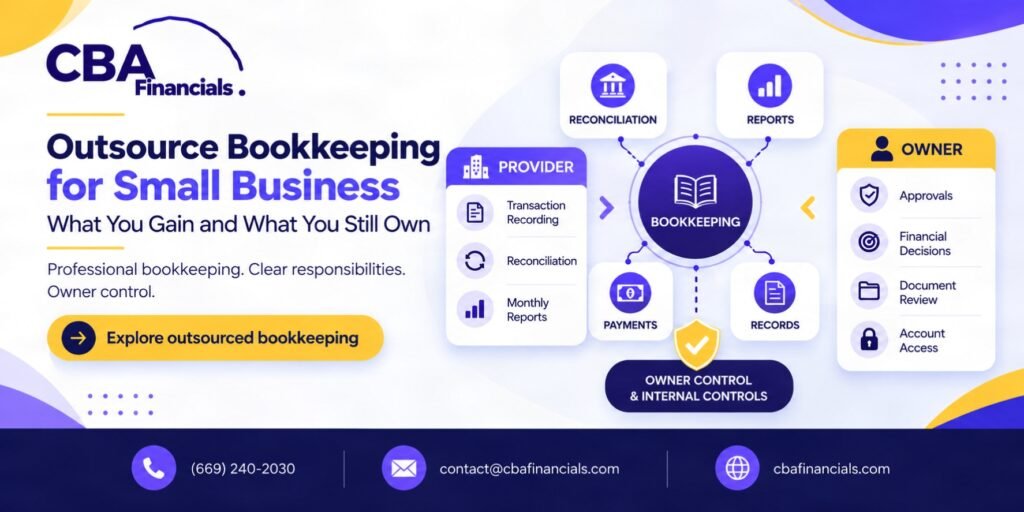
A SIMPLE OWNER AND PROVIDER RESPONSIBILITY GUIDE
The Bookkeeping Provider
- Record transactions
- Reconcile accounts
- Maintain agreed bookkeeping records
- Prepare agreed financial reports
- Identify missing information
- Raise questions about unusual transactions
- Complete the agreed monthly bookkeeping work
The Business Owner
- Provide accurate information
- Provide supporting documents
- Approve important payments
- Review financial reports
- Approve payroll information
- Make spending decisions
- Monitor business performance
- Decide how the business uses its money
- Work with the tax professional when needed
This division can make the relationship much easier to manage.
A SIMPLE MONTHLY PROCESS
Step One
The owner provides invoices, receipts, statements and other needed information.
Step Two
The bookkeeper records and categorizes transactions.
Step Three
Bank and credit card accounts are reconciled.
Step Four
Accounts receivable and accounts payable are reviewed.
Step Five
Payroll transactions are recorded when applicable.
Step Six
Unusual or unclear transactions are discussed with the owner.
Step Seven
The monthly books are completed.
Step Eight
Financial reports are provided to the owner.
Step Nine
The owner reviews the reports and asks questions.
This keeps both sides involved without making the owner responsible for every bookkeeping task.
HOW TO KNOW IF YOUR CURRENT PROVIDER IS DOING ENOUGH
If you already outsource bookkeeping, ask yourself
- Are my books current?
- Are my bank accounts reconciled?
- Do I receive reports on a regular schedule?
- Can my bookkeeper explain unusual transactions?
- Do I understand my financial reports?
- Are my questions answered within an agreed time?
- Do I know who has access to my accounting system?
- Are payment approvals still under my control?
- Does my bookkeeper work well with my tax professional?
- Do I know exactly what is included in my monthly fee?
If several answers are unclear, it may be worth reviewing the current arrangement.
THE RIGHT SETUP GIVES YOU BOTH SUPPORT AND CONTROL
A good outsourced bookkeeping arrangement should not make the owner feel disconnected from the finances.
It should make the financial information easier to understand.
The provider handles the regular bookkeeping work.
The owner remains involved in the decisions.
The accounting system remains accessible.
Reports are reviewed regularly.
Payment controls stay in place.
Supporting documents are maintained.
Responsibilities are clear.
That balance can make outsourced bookkeeping much more useful for a growing small business.
If your books are taking too much time but you still want visibility and control, CBA Financials can help build the right outsourced bookkeeping setup for your business.
Book a Bookkeeping ConsultationFINAL THOUGHTS
The main reason to outsource bookkeeping for small business is not simply to have someone else enter transactions.
It is to create a reliable bookkeeping process while allowing the owner to spend less time on routine financial work.
The provider can handle transaction recording, reconciliations, accounts payable, accounts receivable and financial reports based on the agreed service.
The owner still owns the business decisions, payment approvals, financial review and responsibility for providing accurate information.
The IRS emphasizes that businesses need records that clearly support their income and expenses and that supporting documents should be kept with the business records.
The best arrangement is therefore not one where the owner gives up control.
It is one where the provider handles the bookkeeping work and the owner keeps the right level of oversight.
Explore outsourced bookkeeping to see how a regular bookkeeping process can support your business while keeping important financial decisions in your hands.
