
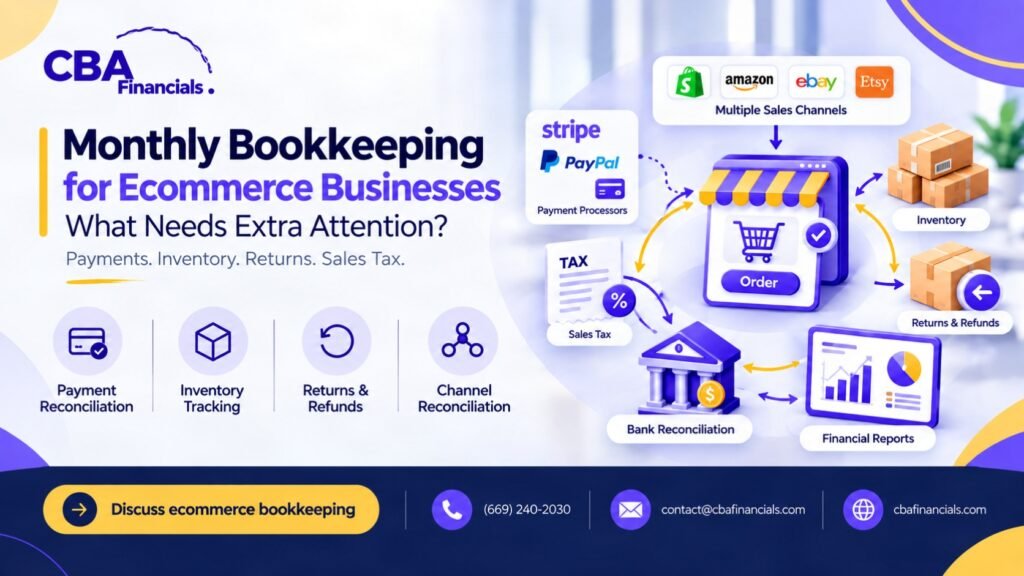
WHY ECOMMERCE BOOKKEEPING NEEDS EXTRA ATTENTION
Traditional bookkeeping can be relatively straightforward when a business has a small number of customers and payments.
Ecommerce businesses often have several systems working at the same time.
Your business may use
- Shopify
- Amazon
- WooCommerce
- Etsy
- eBay
- Stripe
- PayPal
- Shopify Payments
- A bank account
- An inventory system
- An accounting system
Each system can contain different financial information.
The amount shown as sales on your store may not be the amount deposited into your bank account.
The difference can include payment fees, refunds, chargebacks, taxes and other deductions.
That is why ecommerce businesses need regular reconciliation instead of simply matching bank deposits to sales.
WHAT A MONTHLY BOOKKEEPING SERVICE FOR ECOMMERCE SHOULD COVER
A monthly bookkeeping service for ecommerce should be built around the way an online store actually receives and spends money.
The monthly process should normally include
- Sales review
- Payment reconciliation
- Expense recording
- Inventory review
- Returns and refunds
- Sales tax information
- Channel reconciliation
- Monthly financial reporting
The exact work depends on the size and structure of the business.
Not sure whether your ecommerce bookkeeping process is capturing sales, processor fees, inventory, refunds, and channel activity correctly? Have CBA Financials review your monthly bookkeeping setup.
Review Your Ecommerce BookkeepingA small online store with one sales channel may need a simpler process than a growing brand selling through several marketplaces.
PAYMENT PROCESSOR RECONCILIATION
One of the biggest areas that needs attention is payment reconciliation.
A payment processor may send one deposit to your bank even though that deposit represents many individual transactions.
A payout could include
- Customer payments
- Payment processing fees
- Refunds
- Chargebacks
- Other processor adjustments
The bank only shows the final amount that arrived.
Your bookkeeping needs to explain how that amount was created.
This is important because payment reports and bank deposits can show different amounts after fees, refunds and other adjustments. Current ecommerce accounting guidance recommends matching orders and processor activity to payouts and then matching those payouts to bank deposits.
YOUR BANK DEPOSIT IS NOT YOUR SALES REVENUE
This is one of the most common areas of confusion for ecommerce owners.
Suppose your store generates 10,000 dollars in customer payments.
After refunds and payment fees, only 9,400 dollars may reach your bank.
The 9,400-dollar deposit is not necessarily your total sales.
The books should show what happened to the full amount and where the difference went.
This helps keep revenue, refunds and payment fees separate.
It also makes your financial reports easier to understand.
INVENTORY NEEDS REGULAR REVIEW
Inventory is another major difference between ecommerce bookkeeping and many service businesses.
Buying inventory does not automatically mean the entire purchase should be treated as an expense for the current period.
You need to track what you purchased, what you still have and what was sold.
The cost connected to products sold is generally reflected through cost of goods sold.
Your monthly bookkeeping process should review
- Inventory purchases
- Beginning inventory
- Ending inventory
- Products sold
- Product returns
- Damaged products
- Costs connected to products
Inventory records should support the financial statements and help the owner understand actual product profitability.
Current ecommerce accounting guidance also identifies inventory tracking and cost of goods sold as important parts of the bookkeeping process.
RETURNS AND REFUNDS NEED SEPARATE ATTENTION
Returns can make ecommerce numbers difficult to understand if they are not recorded correctly.
A customer may purchase a product in one month and return it in another month.
The business may then issue a refund, receive the product back and place that product back into inventory if it can be resold.
There can be several accounting entries connected to one customer return.
Monthly bookkeeping should review
- Refunds issued
- Products returned
- Payment processor refunds
- Inventory returned to stock
- Damaged or unsellable products
- Shipping costs related to returns
A high number of returns can also affect your understanding of product profitability.
Looking only at gross sales may make a product appear stronger than it really is.
SALES TAX HANDOFFS NEED CLEAR RECORDS
Sales tax can become difficult for ecommerce businesses because customers may be located in many different states.
The business may also sell through marketplaces where the marketplace collects and handles certain taxes.
The treatment can depend on the sales channel and applicable state rules.
This means bookkeeping should clearly identify sales tax amounts and keep the information needed by the person handling sales tax filings.
A monthly bookkeeping process can help maintain
- Sales tax collected
- Sales tax payable
- Sales tax already remitted
- Marketplace tax information
- Sales by state when needed
- Filing information
Sales tax should generally be kept separate from business revenue in the accounting records. Current ecommerce guidance also recommends monitoring sales tax obligations based on the jurisdictions where the business has a collection requirement.
The bookkeeping provider should also be clear about where bookkeeping ends and tax filing responsibility begins.
CHANNEL RECONCILIATION BECOMES IMPORTANT AS YOU GROW
Selling through several channels can create another bookkeeping problem.
You may have one set of sales from your website and additional sales from Amazon, Etsy, eBay or another marketplace.
Each channel may have its own payment schedule and fee structure.
A monthly bookkeeping process should reconcile each major channel separately before combining the information into the financial statements.
This can help answer questions such as
- How much did each channel sell?
- How much did each channel charge in fees?
- How much was refunded?
- How much cash was received?
- How much inventory was sold?
- Which channel is producing better margins?
Current ecommerce accounting guidance recommends connecting sales channels, payment processors, inventory records and bank deposits rather than treating them as separate pieces of information.
SHIPPING COSTS SHOULD NOT BE IGNORED
Shipping can represent a significant cost for an ecommerce business.
You may have
- Shipping paid by customers
- Shipping paid by the business
- Fulfillment charges
- Packaging costs
- Marketplace fulfillment fees
- Returns shipping
These costs should be recorded consistently.
If shipping revenue and shipping expenses are mixed into other accounts, it becomes harder to understand your actual product margins.
Monthly bookkeeping should make these costs visible enough for the owner to review them.
PAYMENT FEES CAN REDUCE YOUR REAL MARGIN
Payment processing fees may look small on individual orders.
Across thousands of orders, they can become a meaningful business expense.
Your monthly books should separate payment fees from sales.
This allows you to see how much the business is spending on payment processing and compare the costs across different payment methods or sales channels.
This can become especially useful when reviewing pricing and product margins.
CHARGEBACKS NEED TO BE TRACKED
Chargebacks can create another difference between your store records and your bank activity.
A chargeback may involve the original sale, a returned payment, a processor fee and potentially additional adjustments.
If chargebacks are not recorded properly, revenue and payment expenses may not match the processor report.
Monthly reconciliation gives you an opportunity to identify these differences before they build up.
ADVERTISING COSTS SHOULD BE VISIBLE
Ecommerce businesses often spend heavily on advertising.
Google Ads, Meta Ads, TikTok Ads and marketplace advertising can all create separate expenses.
These costs should not disappear into a general expense account without proper tracking.
Your financial reports should make it possible to see how much the business is spending to generate sales.
This becomes especially useful when reviewing profitability by product or sales channel.
MONTHLY FINANCIAL REPORTS SHOULD TELL A CLEAR STORY
Bookkeeping should not stop once transactions are entered.
The monthly close should result in financial reports that help you understand the business.
Important reports can include
- Profit and loss statement
- Balance sheet
- Cash flow statement
- Inventory information
- Sales by channel
- Product profitability information when available
The goal is to understand more than total sales.
You should also be able to see what is happening with costs, inventory, cash and profit.
Regular financial review is especially useful for ecommerce businesses because sales, inventory and payment activity can change quickly.
WHAT A MONTHLY ECOMMERCE BOOKKEEPING PROCESS CAN LOOK LIKE
A simple monthly process can follow a consistent order.
First
Collect reports from each sales channel and payment processor.
Second
Review sales, refunds, discounts, fees and chargebacks.
Third
Match processor payouts with bank deposits.
Fourth
Review inventory purchases and product costs.
Fifth
Review returns and inventory adjustments.
Sixth
Update sales tax information.
Seventh
Record operating expenses such as advertising, software, shipping and payroll.
Eighth
Reconcile bank and credit card accounts.
Ninth
Review the financial statements.
Tenth
Follow up on unusual differences before closing the month.
This type of repeatable process can help prevent small errors from becoming larger cleanup problems later.
WHEN ONLINE BOOKKEEPING SERVICES CAN HELP
Some ecommerce owners can manage basic bookkeeping themselves.
The problem often starts when the store becomes more complicated.
Online bookkeeping services can be useful when
- You sell through several channels
- You process a large number of transactions
- Your payment payouts are difficult to reconcile
- Inventory records do not match the books
- Returns are increasing
- You are selling across several states
- You spend too much time working on bookkeeping
- Monthly reports are consistently delayed
- You are unsure about your actual profit
- You need cleaner records before tax preparation
Outsourcing does not remove the owner's responsibility to understand the business records.
It gives the business additional support for maintaining and reviewing them.
Spending too much time reconciling payouts, inventory, refunds, and sales channels? Talk with CBA Financials about a monthly bookkeeping process designed around ecommerce activity.
Discuss Ecommerce BookkeepingWHAT TO ASK BEFORE HIRING AN ECOMMERCE BOOKKEEPING SERVICE
Not every bookkeeping provider understands ecommerce.
Before hiring a provider, ask
Which ecommerce platforms do you work with?
This can help you determine whether the provider understands your actual sales channels.
How do you reconcile payment processors?
The provider should be able to explain how payouts, fees and refunds are handled.
How do you handle inventory?
Ask how inventory purchases, returns and cost of goods sold will be recorded.
How are sales tax records handled?
Make sure you understand whether the provider handles bookkeeping information only or also provides tax filing services.
How often are the books closed?
For many ecommerce businesses, monthly review is important because transaction volume can make errors difficult to find later.
What reports will I receive?
Ask for examples of the financial reports and other information included.
What happens when something does not match?
A good process should include investigation instead of simply forcing numbers to match.
LOCAL BOOKKEEPER OR ONLINE BOOKKEEPING SERVICES
Ecommerce businesses do not always need a bookkeeping provider located in the same city.
Because much of the work involves online platforms and cloud accounting systems, remote bookkeeping can work well for many businesses.
The more important questions are
- Does the provider understand ecommerce?
- Can they work with your sales channels?
- Do they understand payment reconciliation?
- Can they handle inventory records?
- Do they communicate clearly?
- Do they provide monthly reports?
- Do they understand your business model?
Location can matter, but ecommerce experience may matter more than physical distance.
SIGNS YOUR ECOMMERCE BOOKS NEED MORE ATTENTION
Your bookkeeping may need improvement if
- Your bank deposits do not match your sales reports
- You are unsure how much you actually make from each channel
- Inventory numbers are unreliable
- Refunds are not recorded consistently
- Payment fees are mixed with revenue
- Sales tax balances do not make sense
- Monthly reports arrive late
- You cannot explain large changes in profit
- You regularly need bookkeeping cleanup before tax filing
- You are making business decisions without current financial information
These problems do not necessarily mean your business needs a larger accounting department.
If your ecommerce reports are late, deposits do not match sales, or profitability is difficult to explain, CBA Financials can help you identify where the bookkeeping process needs attention.
Book a Bookkeeping ReviewThey may simply mean the bookkeeping process needs to be designed around ecommerce activity.
WHAT MANY ECOMMERCE BOOKKEEPING GUIDES MISS
Many ecommerce bookkeeping articles focus on recording sales and expenses.
That is important, but there is another issue that deserves attention.
The books need to connect the different systems used by the business.
A store report may show one number.
The payment processor may show another.
The bank may show a third.
The inventory system may show something different again.
The real value of monthly ecommerce bookkeeping is bringing those records together and investigating differences.
This is particularly important for growing businesses because more sales channels and higher transaction volume can create more reconciliation work. Current ecommerce guidance also highlights the need to connect sales channels, processors, inventory records and bank deposits.
This gives business owners a clearer view of what they actually sold, what they actually received and what it cost to generate those sales.
A SIMPLE ECOMMERCE BOOKKEEPING CHECKLIST
Sales
Are all sales recorded?
Payment Processors
Do processor reports match the books?
Bank Deposits
Do payouts match the deposits?
Refunds
Are all refunds recorded?
Chargebacks
Have chargebacks been reviewed?
Inventory
Do inventory records support the books?
Product Costs
Are cost of goods sold entries current?
Sales Tax
Are tax amounts recorded correctly?
Shipping
Are shipping costs recorded consistently?
Advertising
Are major advertising expenses included?
Financial Reports
Have the monthly reports been reviewed?
Unusual Items
Have unexpected differences been investigated?
FINAL THOUGHTS
Ecommerce bookkeeping is different from ordinary small business bookkeeping because money and financial information can move through several systems before reaching the books.
A strong monthly bookkeeping service for ecommerce should pay close attention to payment processors, inventory, returns, sales tax information, channel reconciliation and financial reporting.
The goal is not simply to keep transactions organized.
The goal is to give the business owner financial records that can be understood and used.
If your ecommerce business is growing and bookkeeping is becoming harder to keep up with, professional support can help you maintain cleaner monthly records and spend less time trying to reconcile the numbers yourself.
Discuss ecommerce bookkeeping with CBA Financials to review your current bookkeeping process and determine what support your business may need.
