WHY ASK QUESTIONS BEFORE HIRING AN ACCOUNTING PROVIDER?
Many business owners start their search by comparing prices. Cost is important, but it should not be the only thing you consider.
Two accounting firms may offer similar looking packages while providing very different levels of support.
One provider may only record transactions each month. Another may also reconcile accounts, prepare financial reports, answer questions, help with cash flow planning, and work with your tax professional.
Asking the right questions helps you understand the difference.
Not sure what your business actually needs from an accounting provider? CBA Financials can help you review your bookkeeping, reporting, payroll, tax support, and financial workflow.
Review Your Accounting NeedsIt can also prevent problems such as unclear pricing, missed deadlines, incomplete records, or services you thought were included but were not.
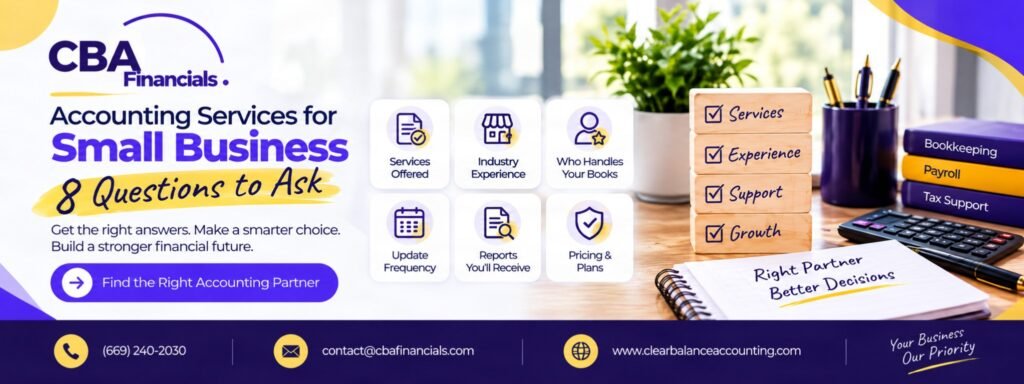
8 QUESTIONS TO ASK BEFORE CHOOSING ACCOUNTING SERVICES FOR SMALL BUSINESS
1. What Accounting Services Do You Provide
Start by asking exactly what the accounting firm will handle for your business.
Small business accounting services can include different tasks depending on the provider.
Common services may include
- Monthly bookkeeping
- Bank and credit card reconciliation
- Accounts payable
- Accounts receivable
- Payroll support
- Financial statements
- Expense tracking
- General ledger management
- Bookkeeping cleanup
- Tax preparation support
- Cash flow reporting
- Budgeting and forecasting
You should also ask what is not included.
For example, a monthly bookkeeping package may not include payroll, tax filing, cleanup work, or financial planning.
Knowing the full scope of the service before you sign an agreement can help avoid confusion later.
2. Do You Work with Businesses Like Mine?
Accounting needs can vary from one business to another.
A construction company may need help tracking project costs. A professional service business may focus more on billing and accounts receivable. A retail business may have inventory and sales tax requirements to consider.
Ask the provider whether they have experience working with businesses similar to yours.
You can ask about your industry, business size, accounting software, number of monthly transactions, payroll needs, and other factors that affect your accounting work.
Experience with similar businesses does not guarantee a perfect fit, but it can make it easier for the provider to understand your day to day needs.
3. Who Will Actually Handle My Books?
This is a simple question that many business owners forget to ask.
You may speak with an accounting firm owner or manager during the sales process, but another person may handle your daily bookkeeping.
Ask who will be responsible for your account.
You can also ask whether you will have one regular contact person or communicate with different members of the team.
A clear point of contact can make it easier to ask questions, provide documents, and resolve issues.
It is also useful to understand how the firm handles staff changes or periods when your usual contact is unavailable.
4. How Often Will My Accounts Be Updated?
Ask how often your books will be updated and reconciled.
Some businesses may need monthly accounting. Others with high transaction volume or tighter cash flow needs may need more frequent updates.
Regular updates can help you see important changes in your business without waiting until tax time.
Ask questions such as
- How often are bank accounts reconciled?
- When will monthly books be completed?
- When will financial reports be available?
- How are missing documents handled?
- What happens if a transaction needs clarification?
A clear monthly process can help keep your financial records current and useful.
5. What Financial Reports Will I Receive?
Bookkeeping is not only about recording transactions.
Your financial reports should help you understand what is happening in your business.
Ask which reports are included with your accounting service.
Common reports include
- Profit and loss statement
- Balance sheet
- Cash flow information
- Accounts receivable reports
- Accounts payable reports
Depending on your business, you may also need reports related to inventory, job costs, sales, or specific business locations.
It is also worth asking whether the provider will explain the reports.
A report is more useful when you understand what the numbers mean and what questions you should ask about them.
6. How Do You Handle Tax Support?
Accounting and tax work are closely connected, but they are not always the same service.
Ask whether the accounting provider prepares tax returns, works with your tax professional, or only maintains your books.
You should also ask how they prepare your records for tax filing.
Good financial records can make tax preparation easier because income and expenses are organized throughout the year.
If your accounting provider does not prepare your tax return, ask how they coordinate with your tax professional when needed.
This can help reduce duplicate work and make it easier to provide accurate financial information.
7. How Do You Charge for Your Services?
Pricing should be clear before you begin.
Ask whether the provider charges a monthly fee, hourly rate, project fee, or another pricing structure.
Also ask what could cause the price to change.
For example, your monthly fee could be affected by
- Higher transaction volume
- Additional bank or credit card accounts
- Payroll services
- Cleanup work
- Sales tax support
- Additional reporting
- New business locations
- Special accounting requests
A low monthly price may not be the lowest overall cost if important services are charged separately.
Ask for a clear explanation of what is included and what costs extra.
8. How Will We Communicate and Share Documents?
Good communication is an important part of accounting support.
Ask how you will communicate with the accounting team.
The provider may use email, phone calls, video meetings, a client portal, or accounting software.
You should also ask how financial documents will be shared and stored.
Find out how you will provide bank statements, receipts, invoices, payroll information, and other records.
It is also helpful to know how quickly you can expect a response when you have a question.
Clear communication can make the accounting process much easier for both sides.
WHAT TO LOOK FOR WHEN COMPARING SMALL BUSINESS ACCOUNTING SERVICES NEAR ME
If you are searching online for small business accounting services near me, you will probably find many local firms and remote providers.
Location can be useful, but it should not be your only consideration.
Start by looking at the services offered and whether they match your business needs.
Then consider
- Experience with businesses like yours
- Communication process
- Accounting software experience
- Reporting options
- Pricing structure
- Tax support
- Availability
- Bookkeeping process
- Document security
- Client reviews and references
If meeting in person matters to you, ask whether the provider offers local meetings.
If you are comfortable working remotely, you may have more options because many accounting firms can manage bookkeeping and financial records online.
The important thing is to choose a setup that works well for your business.
Comparing local and remote accounting providers? Talk with CBA Financials about the service scope, communication, and reporting setup that fits your business.
Compare Accounting OptionsWHAT SHOULD BE INCLUDED IN SMALL BUSINESS ACCOUNTING SERVICES
There is no single package that works for every business.
However, a useful accounting service should clearly explain what work will be completed and when.
Depending on your needs, you may expect services such as
Accurate Bookkeeping
Transactions should be recorded properly and categorized consistently.
Account Reconciliation
Bank and credit card accounts should be reviewed against your accounting records to identify differences or missing transactions.
Financial Reports
You should receive reports that help you understand revenue, expenses, profit, assets, liabilities, and other important financial information.
Organized Records
Your financial information should be maintained in a way that makes it easier to review and use later.
Ongoing Communication
You should know who to contact when you have questions or need help with your records.
Clear Responsibilities
You and the accounting provider should both understand who is responsible for specific tasks.
QUESTIONS TO ASK ABOUT YOUR FIRST MONTH
The first month can be different from normal monthly bookkeeping because the provider may need to review your existing records.
Ask whether the accounting firm will
- Review your existing books
- Check previous reconciliations
- Identify missing transactions
- Review account balances
- Clean up old accounting issues
- Set up a regular monthly process
- Confirm which documents you need to provide
This is especially important if your books have not been maintained regularly.
A provider should explain what needs to be corrected instead of simply moving forward with incomplete information.
WHAT IF YOUR BOOKS ARE BEHIND
Many small businesses look for accounting help after falling behind on their bookkeeping.
That does not necessarily mean you need to start from the beginning.
Ask whether the accounting firm offers bookkeeping cleanup.
Cleanup may involve reviewing old transactions, correcting account classifications, reconciling accounts, and bringing records up to date.
Make sure you ask whether cleanup is included in your regular monthly fee or billed separately.
It is also important to understand whether the provider will explain major issues found during the cleanup.
LOCAL ACCOUNTING SERVICES VERSUS REMOTE SUPPORT
A local accounting provider can offer the convenience of working with a business in your area.
Some owners prefer face to face meetings and having a nearby professional they can contact.
Remote accounting services can also provide regular bookkeeping, reporting, and financial support without requiring an office visit.
When comparing providers, focus on how the service will actually work for you.
Ask yourself whether you need local meetings or whether online communication is enough.
For some businesses, location will be important. For others, experience, communication, service options, and availability may matter more.
RED FLAGS TO WATCH FOR
There are a few things worth paying attention to before hiring an accounting provider.
Be cautious when a provider cannot clearly explain what is included in the service.
You should also ask more questions if
- Pricing is difficult to understand
- Responsibilities are not clearly defined
- You cannot identify who handles your account
- Reports are not explained
- Communication expectations are unclear
- Cleanup work is not discussed when your books are behind
- Important services are mentioned only after you sign up
The goal is not to find a provider with the longest service list. The goal is to find one that clearly understands what your business needs.
A SIMPLE ACCOUNTING PROVIDER COMPARISON CHECKLIST
Before choosing accounting services for small business, compare providers using the same questions.
Ask each provider
- What services are included?
- What services cost extra?
- Who handles my account?
- How often are books updated?
- When are monthly reports delivered?
- Which financial reports are included?
- How is bookkeeping cleanup handled?
- Do you support payroll?
- Do you provide tax preparation or tax support?
- How will we communicate?
- How will documents be shared?
- How is pricing determined?
- Can you work with my existing accounting software?
- What happens if my business grows?
Writing down the answers can make it much easier to compare different accounting firms.
Before choosing an accounting firm, compare the actual services, reporting, pricing, and responsibilities. CBA Financials can help you review your options.
Book a ConsultationHOW THE RIGHT ACCOUNTING SUPPORT CAN HELP A SMALL BUSINESS
Reliable accounting support can give a business owner more organized financial records and a clearer view of business activity.
Instead of spending hours entering transactions or trying to understand accounting reports, you can have a regular process for keeping your books updated.
Accurate records can also make it easier to review business performance, prepare for tax filing, manage cash flow, and make informed financial decisions.
The value of accounting services is not only in keeping records.
It is also in having financial information you can use when running the business.
WHEN SHOULD YOU HIRE SMALL BUSINESS ACCOUNTING SERVICES
You do not have to wait until your books become a problem before getting accounting help.
You may want to consider professional accounting support when
- Bookkeeping takes too much of your time
- Your records are falling behind
- You are unsure whether your books are accurate
- You are growing and your transactions are increasing
- You have employees or contractors
- You need regular financial reports
- You are preparing for tax filing
- You are having trouble tracking cash flow
- You want more time to focus on running the business
Getting help earlier can make it easier to establish a consistent accounting process.
FINAL THOUGHTS
Choosing accounting services for small business is about more than finding someone to record transactions.
You want to understand what the provider will handle, how often your books will be updated, what reports you will receive, how communication will work, and what you can expect to pay.
Asking these eight questions can give you a clearer picture before you make a decision.
If you are comparing small business accounting services near me or looking for ongoing accounting support, take the time to discuss your business needs with a professional before choosing a service.
SCHEDULE AN ACCOUNTING CONSULTATION
If you need help understanding your accounting needs or want to discuss the right service for your business, CBA Financials can help you review your options.
Schedule an accounting consultation to discuss your bookkeeping and accounting needs.