
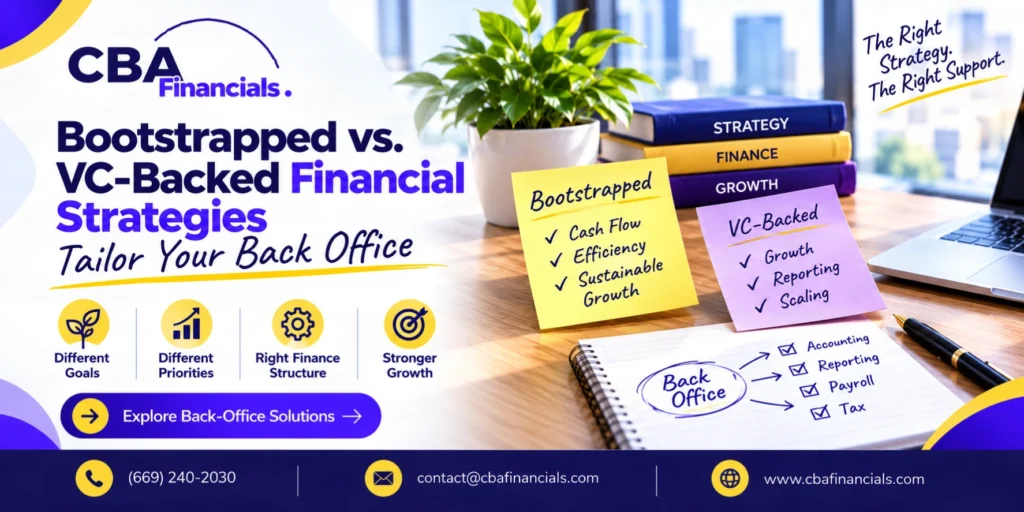
WHAT IS THE DIFFERENCE BETWEEN BOOTSTRAPPED AND VC-BACKED STARTUPS?
A bootstrapped company generally relies heavily on founder resources, customer revenue, and reinvested operating cash rather than institutional venture capital. A venture-backed company has raised external equity capital from investors to support the company's growth.
These structures can create different financial priorities.
A bootstrapped company may place greater emphasis on:
- Cash generation
- Gross margin
- Collections
- Operating efficiency
- Break-even planning
- Careful hiring
- Sustainable growth
A venture-backed company may place greater emphasis on:
- Growth targets
- Cash runway
- Capital deployment
- Investor reporting
- Forecasting
- Fundraising milestones
- Equity and financing transactions
These are general patterns, not fixed rules.
A bootstrapped company can invest heavily in growth. A VC-backed company can operate conservatively.
The funding structure provides context, but the actual business model and strategy should determine financial decisions.
WHY THE BACK OFFICE NEEDS TO MATCH THE FUNDING MODEL?
The back office includes much more than bookkeeping.
It can include:
- Accounting
- Accounts payable
- Accounts receivable
- Payroll
- Financial reporting
- Cash management
- Budgeting
- Forecasting
- Tax compliance
- Financial controls
- Investor reporting
- Management reporting
As the company grows, these functions need to work together.
A startup may begin with a founder reviewing transactions and a bookkeeper maintaining the accounting system.
Later, the company may need monthly close procedures, financial forecasts, cash reporting, budgeting, and more formal controls.
The right structure depends on the company's needs.
BOOTSTRAPPED BUSINESS ACCOUNTING: WHAT MATTERS MOST
For a bootstrapped company, available cash can have a direct relationship with the company's ability to continue operating and fund growth.
That makes financial visibility especially important.
1. Clean Bookkeeping
Accurate bookkeeping provides the foundation.
Management should know:
- How much revenue was generated
- What expenses were incurred
- How much cash is available
- What customers owe
- What the company owes vendors
- Whether the business is profitable
Poor bookkeeping can make otherwise reasonable business decisions much harder.
2. Cash Flow Management
A profitable business can still experience cash pressure.
Bootstrapped companies should monitor:
- Customer payment timing
- Accounts receivable
- Vendor payment obligations
- Payroll
- Taxes
- Recurring expenses
- Planned investments
Cash flow forecasting can help founders identify future pressure before it becomes an immediate problem.
3. Margin Management
When external capital is limited, understanding margins becomes particularly useful.
Founders should know:
Revenue − direct costs = gross profit
Then evaluate how much gross profit remains after operating expenses.
This can help management understand which products, services, or customer segments contribute most effectively to the company's financial position.
4. Break-Even Planning
A bootstrapped company may place significant attention on reaching or maintaining break-even.
Break-even analysis can help answer:
- How much revenue do we need to cover our operating costs?
- How many customers are required?
- What happens if pricing changes?
- What happens if expenses increase?
These questions can help connect operating decisions to financial outcomes.
Need dependable books without a large finance team? Explore bookkeeping support tailored to a lean startup.
Explore Bookkeeping SupportSTARTUP CAPITAL ALLOCATION IN A BOOTSTRAPPED COMPANY
When capital comes primarily from the founder and operating revenue, each dollar may require a clear business purpose.
That does not mean every expense should be minimized.
Instead, founders can categorize spending into areas such as:
Essential operations
Expenses required to keep the company functioning.
Revenue-generating activities
Sales, marketing, customer acquisition, and other activities intended to generate future revenue.
Product and service development
Investments that improve the offering or delivery capability.
Infrastructure
Technology, systems, accounting, legal, compliance, and other support functions.
Optional spending
Expenses that may provide value but are not immediately necessary.
This framework can help founders prioritize spending without treating every cost as equally important.
HOW VENTURE-BACKED FINANCIAL STRATEGY CAN DIFFER
A venture-backed company has access to external equity capital, but that does not eliminate the need for financial discipline.
In many cases, the focus shifts toward deploying capital against specific growth objectives.
For example, funding may support:
- Hiring
- Product development
- Sales expansion
- Marketing
- Geographic expansion
- Technology infrastructure
- Customer acquisition
- Working capital
The financial question becomes more than:
Can we afford this expense?
It may also become:
What business milestone is this expense expected to support?
That distinction can change how management evaluates spending.
BUILD A CLEAR USE-OF-FUNDS FRAMEWORK
After raising capital, founders should understand where the money is expected to go.
A simple framework might divide capital among:
- Product
- Engineering
- Sales
- Marketing
- Operations
- General and administrative
- Working capital
- Strategic initiatives
The exact allocation should depend on the company's strategy.
The important point is to connect spending with measurable objectives.
For example:
- Hiring additional sales staff → increase sales capacity
- Product investment → release planned features
- Marketing investment → increase qualified demand
- Operations investment → support larger customer volume
This makes capital allocation easier to review.
RUNWAY BECOMES A CORE METRIC
For a venture-backed startup, available cash and expected future spending often need to be evaluated together.
A basic runway calculation is:
Cash runway = available cash ÷ monthly net burn
For example, if a company has $1.8 million in available cash and an average monthly net burn of $150,000, the simple calculation indicates approximately 12 months of runway.
But this should not be treated as a fixed number.
Hiring, revenue growth, customer collections, and other changes can alter the burn rate.
A forward-looking cash forecast is therefore more useful than simply dividing the bank balance by one month's spending.
Want better visibility into burn rate, runway, and growth scenarios? Discuss financial forecasting support with CBA Financials.
Discuss Runway PlanningINVESTOR REPORTING CHANGES THE FINANCE FUNCTION
Venture-backed startups may need more structured reporting because investors and boards often need regular visibility into company performance.
Depending on the company and its financing arrangements, management reporting may include:
- Income statement
- Balance sheet
- Cash flow
- Budget vs. actual results
- Cash runway
- Revenue metrics
- Customer metrics
- Headcount
- Hiring plans
- Key operating metrics
Current startup accounting guidance also highlights the increasing importance of consistent monthly reporting, forecasting, financial controls, and investor visibility as funded startups grow.
The exact reporting package should be agreed with the company's investors, board, finance team, and advisors.
EQUITY ACCOUNTING REQUIRES ADDITIONAL ATTENTION
Venture-backed companies may have financial instruments that are less common in a traditional small business.
Depending on the company's financing structure, these can include:
- Preferred stock
- SAFEs
- Convertible notes
- Stock options
- Warrants
These transactions need to be properly documented and reflected in the accounting records.
The accounting treatment can vary depending on the instrument and applicable accounting rules.
That is one reason venture-backed companies often need stronger coordination between founders, accountants, attorneys, and other financial professionals.
BOOTSTRAPPED VS. VC-BACKED REPORTING PRIORITIES
The difference can be summarized at a high level:
| Area | Bootstrapped Business | VC-Backed Business |
|---|---|---|
| Primary financial focus | Cash generation and efficiency | Growth, capital deployment, and runway |
| Revenue | Current and recurring revenue | Growth and future revenue potential |
| Expenses | Closely evaluated against cash generation | Evaluated against growth plans and milestones |
| Cash management | Protect operating cash | Manage runway and planned capital use |
| Forecasting | Revenue, expenses, cash flow | Revenue, burn, runway, hiring, scenarios |
| Reporting | Management-focused | Management plus investor or board reporting |
| Capital allocation | Reinvestment of operating cash | Deployment of external capital and operating cash |
| Financial controls | Scale with business complexity | Often become more formal as funding and reporting needs increase |
These are planning tendencies rather than rules. The appropriate setup depends on the company's stage, industry, financial complexity, and stakeholder requirements.
THE MONTHLY CLOSE MATTERS FOR BOTH
Regardless of funding model, founders need reliable financial information.
A monthly close process can help establish consistency.
A basic process may include:
- 1. Record all transactions
- 2. Reconcile bank and credit card accounts
- 3. Review accounts receivable
- 4. Review accounts payable
- 5. Record payroll
- 6. Review accruals and other adjustments where applicable
- 7. Review financial statements
- 8. Compare actual results with the budget or forecast
- 9. Investigate significant variances
A consistent close process gives management a reliable starting point for financial decisions.
FORECASTING SHOULD REFLECT THE COMPANY'S REALITY
The financial model for a bootstrapped company may emphasize cash generation and sustainable growth.
A VC-backed model may include multiple growth scenarios, hiring plans, financing assumptions, and milestone planning.
But both models should start with realistic operating assumptions.
For example:
- How many customers can the sales team realistically acquire?
- What is the expected average revenue per customer?
- How quickly do customers pay?
- How much does it cost to serve them?
- When will new employees begin?
- What expenses increase as revenue grows?
A model becomes more useful when it connects financial results to actual business drivers.
HOW BACK-OFFICE TECHNOLOGY CAN SCALE WITH THE COMPANY
Technology should solve a real problem.
An early-stage company may only need a relatively simple accounting and expense-management setup.
As activity increases, the business may need:
- Automated transaction feeds
- Expense approval workflows
- Accounts payable systems
- Payroll integration
- Financial dashboards
- Forecasting tools
- Automated reporting
- Document management
- Stronger access controls
The goal is not to purchase the largest technology stack available.
It is to create a system that produces accurate information efficiently.
WHEN SHOULD A STARTUP OUTSOURCE ACCOUNTING?
Outsourcing can be useful when the business needs more financial support than the internal team can provide but is not ready to build a large finance department.
A startup may consider outsourced accounting when:
- The founder is spending too much time on bookkeeping
- Financial reports are consistently delayed
- Cash flow visibility is limited
- The company is preparing for fundraising
- Investor reporting is becoming more demanding
- The accounting system needs cleanup
- The business has grown beyond basic bookkeeping
- Management needs financial planning support
The appropriate level of external support depends on the company's needs.
Some businesses may need bookkeeping.
Others may need accounting plus controller support.
A growing company may eventually need fractional CFO or full-time finance leadership.
Outgrowing founder-managed bookkeeping? Review the right mix of accounting and financial leadership for your stage.
Review Your Finance SetupCOMMON MISTAKES BOOTSTRAPPED FOUNDERS SHOULD AVOID
Mixing personal and business finances
Separate accounts and clear transaction records make accounting and reporting easier to manage.
Using the bank balance as the only financial metric
A bank balance tells you what cash exists today.
It does not necessarily tell you what cash will be available after upcoming obligations.
Delaying bookkeeping
Waiting until tax time can make it difficult to understand current performance.
Ignoring accounts receivable
Revenue that has not been collected may not help fund current operations.
Cutting productive expenses automatically
Reducing a cost without understanding its contribution to revenue or operations can create unintended consequences.
COMMON MISTAKES VC-BACKED FOUNDERS SHOULD AVOID
Treating raised capital as unlimited operating cash
Funding provides resources, but those resources still need to be managed.
Assuming the next funding round is guaranteed
Future financing should be treated as a planning scenario rather than cash already available.
Delaying financial infrastructure
As the company grows, poor records can create additional work during due diligence, reporting, or financing processes.
Ignoring investor reporting requirements
The reporting expectations should be understood and incorporated into the finance calendar.
Spending without measurable objectives
Capital allocation becomes more useful when significant spending is connected to specific business goals.
WHEN A HYBRID STRATEGY MAKES SENSE
Some startups do not remain exclusively bootstrapped or exclusively venture-backed.
A company may use founder capital and customer revenue during its early stages and later raise outside capital.
Another company may raise capital while still maintaining a strong focus on cash efficiency.
This means the back-office approach may need to evolve.
A company that begins with basic bookkeeping may later need:
- Monthly financial statements
- Cash forecasting
- Budgeting
- Investor reporting
- Financial controls
- Equity accounting
- Scenario planning
The finance function should evolve as the company's funding and operating complexity changes.
A PRACTICAL BACK-OFFICE FRAMEWORK
Regardless of funding structure, founders can use a simple framework.
Step 1: Establish clean accounting records
Make sure transactions are categorized accurately and accounts are reconciled.
Step 2: Create a monthly reporting routine
Know when financial statements will be completed and reviewed.
Step 3: Track cash
Monitor current cash, expected collections, and upcoming obligations.
Step 4: Build a forecast
Connect revenue and expenses to operating assumptions.
Step 5: Review capital allocation
Understand where money is being spent and what each major investment is expected to accomplish.
Step 6: Match reporting to stakeholders
Determine what management, lenders, investors, or board members need to see.
Step 7: Add controls as complexity increases
Approval processes, documentation, reconciliations, and access controls should evolve with the business.
Step 8: Revisit the finance structure regularly
Your finance needs at $500,000 in revenue may look very different from your needs at $5 million.
THE RIGHT BACK OFFICE IS NOT ABOUT BEING BIGGER
One of the most important lessons for founders is that financial infrastructure should be proportional to the business.
A bootstrapped startup does not need to imitate the finance department of a large corporation.
A venture-backed company should not assume that every available dollar needs to be spent simply because investors provided it.
Both types of companies need accurate information.
Both need cash visibility.
Both need financial controls.
Both need useful forecasting.
The difference is how those tools support the company's funding structure and strategic objectives.
FINAL THOUGHTS
Bootstrapped business accounting and a venture backed financial strategy can require different priorities, even though both rely on the same fundamental need for accurate financial information.
For a bootstrapped company, financial management may center heavily on cash generation, margins, collections, and disciplined reinvestment.
For a venture-backed company, the focus may expand to include capital deployment, runway, investor reporting, growth planning, and more complex financial instruments.
In either case, startup capital allocation should be connected to the company's actual goals and operating realities.
The strongest back-office approach is not necessarily the most complicated one.
It is the one that gives founders accurate numbers, clear cash visibility, reliable reporting, and the information needed to make informed decisions.
As your startup grows, your financial infrastructure should grow with it.
Need help building a finance function that matches your startup's funding and growth stage?
Book a startup finance consultation with CBA Financials to discuss accounting, forecasting, cash flow, and strategic financial support.
