
WHY SMALL BUSINESSES NEED A TAX PREPARATION CHECKLIST
Tax preparation is more than collecting receipts at the end of the year.
Your tax return may depend on information from your bank accounts, accounting records, payroll records, invoices, equipment purchases, loans, business expenses, and previous tax returns.
Missing one important document can create extra work later.
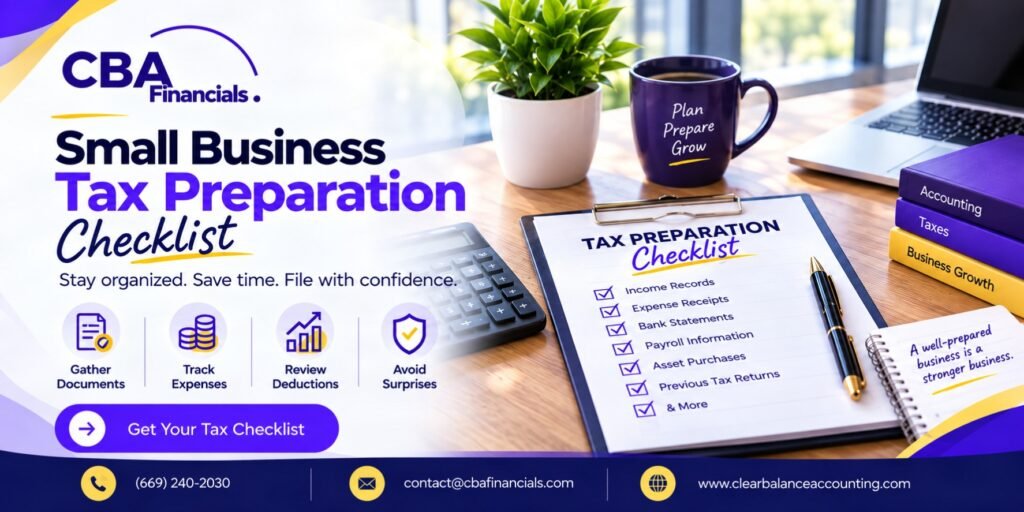
A checklist gives you a simple way to review your records before your tax preparation begins.
It can help you
- Gather business income records
- Organize business expenses
- Review payroll information
- Check business asset purchases
- Review loans and business debt
- Gather previous tax returns
- Identify major business changes
- Review estimated tax payments
- Separate personal and business transactions
- Prepare questions for your tax professional
The IRS states that good records help businesses prepare financial statements, identify income, track deductible expenses, prepare tax returns, and support information reported on those returns.
Want to make tax preparation easier before filing season gets busy? CBA Financials can help you review your records and identify what is still missing.
Prepare for Tax FilingSMALL BUSINESS TAX PREPARATION CHECKLIST
Use the following checklist before you begin your tax preparation.
You can also save this page as a reference or turn it into a small business tax preparation checklist PDF for your records.
1. GATHER YOUR BUSINESS INCOME RECORDS
Start with all sources of business income.
Your tax professional needs a complete picture of the money your business earned during the tax year.
Review your
- Sales invoices
- Customer payments
- Business bank deposits
- Credit card sales
- Online payment platforms
- Cash sales
- 1099 forms received
- Other business income
Compare your income records with your accounting records and bank statements.
This can help identify income that may have been recorded incorrectly or left out.
The IRS recommends keeping documents that support gross receipts such as invoices, deposit information, receipt records, and applicable information returns.
2. ORGANIZE YOUR BUSINESS EXPENSE RECORDS
Business expenses are another important part of tax preparation.
Go through your accounting records and supporting documents to make sure your expenses are properly recorded.
Review expenses such as
- Advertising and marketing
- Office supplies
- Software and subscriptions
- Professional services
- Insurance
- Rent
- Utilities
- Telephone and internet
- Business travel
- Vehicle expenses
- Repairs and maintenance
- Bank and payment processing fees
- Contractor payments
- Other ordinary business expenses
Keep receipts, invoices, statements, and other documents that support the expenses recorded in your books.
The IRS explains that supporting documents can include paid bills, invoices, receipts, deposit slips, credit card records, and canceled checks.
3. REVIEW YOUR BANK AND CREDIT CARD ACCOUNTS
Your business bank accounts can help you find transactions that may have been missed in your accounting records.
Before tax preparation begins
- Reconcile business bank accounts
- Reconcile business credit cards
- Review unusual transactions
- Check outstanding transactions
- Identify personal expenses paid from business accounts
- Identify business expenses paid personally
- Review transfers between accounts
If your business and personal transactions are mixed together, identify them before giving your records to your tax professional.
Keeping business and personal finances separate can make bookkeeping and tax preparation easier.
4. CHECK YOUR ACCOUNTING RECORDS
Your books should be reasonably up to date before tax preparation starts.
Review your
- Profit and loss statement
- Balance sheet
- General ledger
- Accounts receivable
- Accounts payable
- Bank reconciliations
- Credit card reconciliations
- Owner transactions
- Loan balances
- Fixed asset records
The IRS notes that business books should provide a clear summary of business transactions and show income, deductions, and credits.
If your books are several months behind, consider completing the bookkeeping work before starting the tax return.
5. GATHER PAYROLL RECORDS
If you have employees, payroll information should be included in your tax preparation process.
Gather
- W-2 records
- W-3 information
- Payroll reports
- Employer tax filings
- Payroll tax payments
- Employee compensation records
- Contractor payment records
- 1099 information where applicable
Employment tax records have their own recordkeeping requirements. The IRS generally requires employers to keep employment tax records for at least four years.
6. REVIEW CONTRACTOR PAYMENTS
If your business paid independent contractors during the year, review those payments before filing.
Check
- Contractor names
- Payment amounts
- W-9 records
- 1099 information
- Contractor invoices
- Payment records
Make sure contractor information in your accounting records matches your supporting documents.
Your tax professional can help determine which payments require information reporting based on your specific situation.
7. GATHER RECORDS FOR BUSINESS ASSETS
Did your business purchase equipment, vehicles, computers, furniture, machinery, or other significant property during the year?
If yes, gather the related records.
- Purchase invoices
- Date of purchase
- Purchase price
- Financing information
- Improvement costs
- Previous depreciation records
- Sale or disposal information
- Related receipts
Asset records can affect depreciation and the tax treatment of a later sale or disposal.
The IRS recommends keeping records showing information such as when an asset was acquired, its purchase price, improvements, depreciation, business use, and disposal information.
8. REVIEW BUSINESS LOANS AND DEBT
Business loans can affect your financial records and tax preparation.
Gather
- Loan statements
- New loans taken during the year
- Loan payments
- Interest paid
- Business credit lines
- Loan balances
- Financing documents
Separate principal payments from interest and make sure your accounting records reflect the transactions correctly.
If you received a new loan, purchased equipment through financing, or refinanced existing debt, tell your tax professional.
9. REVIEW YOUR VEHICLE AND TRAVEL RECORDS
If you use a vehicle for business or have business travel expenses, gather the records supporting those costs.
Review
- Business mileage
- Vehicle expenses
- Fuel records
- Repairs
- Insurance
- Parking
- Tolls
- Business travel expenses
- Hotel expenses
- Transportation costs
Keep enough information to support the business purpose and amount of the expense.
Do not assume that every vehicle or travel expense is automatically deductible. The tax treatment can depend on how the expense was incurred and how the vehicle or travel was used.
10. CHECK YOUR HOME OFFICE INFORMATION
If you work from home, gather the information your tax professional may need to determine whether you qualify for a home office deduction.
You may need information about
- Home office area
- Total home area
- Rent or mortgage information
- Utilities
- Insurance
- Repairs
- Other relevant home expenses
Your tax professional can determine whether the requirements for a home office deduction apply to your situation.
11. GATHER YOUR PREVIOUS TAX RETURNS
Keep a copy of your previous federal and state tax returns available.
Your previous return can help your tax professional review
- Prior year income
- Carryforward items
- Depreciation information
- Business losses
- Estimated tax payments
- Prior year balances
- Other tax information
Keeping copies of filed returns can also make future tax preparation easier. The IRS recommends keeping copies of filed tax returns.
12. REVIEW ESTIMATED TAX PAYMENTS
If you made estimated tax payments during the year, gather the payment information.
Check
- Federal estimated tax payments
- State estimated tax payments
- Payment dates
- Payment amounts
- Payment confirmations
- Any tax balance or credit from the previous year
Make sure the payments recorded in your accounting records agree with your payment confirmations.
13. TELL YOUR TAX PROFESSIONAL ABOUT MAJOR BUSINESS CHANGES
One area that is often overlooked is business changes.
Your tax professional should know about important events that happened during the year.
Tell them if you
- Started a new business
- Closed a business
- Changed your business structure
- Added or removed an owner
- Bought another business
- Sold part or all of the business
- Purchased major equipment
- Sold business property
- Took on significant debt
- Hired employees
- Started working with contractors
- Opened or closed business locations
- Expanded into another state
These changes can affect the information needed for your tax return.
14. REVIEW YOUR BUSINESS STRUCTURE
Your business structure can affect how your business income and taxes are reported.
Before tax preparation, confirm whether your business operates as a
- Sole proprietorship
- Partnership
- S corporation
- C corporation
- LLC with applicable tax treatment
If your business structure changed during the year, make sure your tax professional knows when the change occurred and what documents were filed.
15. REVIEW STATE AND LOCAL TAX REQUIREMENTS
Federal tax preparation is only part of the process for many businesses.
Depending on where you operate and what your business does, you may also have state or local tax responsibilities.
Review
- State income tax requirements
- State business tax filings
- Sales tax records
- Local tax filings
- Payroll tax requirements
- Business licenses or tax registrations
- Other state or local requirements
State and local requirements can differ from federal requirements, so discuss your situation with a qualified tax professional.
16. LOOK FOR MISSING RECORDS
Before sending your information for tax preparation, take a final look for missing documents.
Ask yourself
- Are all business bank statements available?
- Are all credit card statements available?
- Are all income records included?
- Are all major expenses supported?
- Are asset purchases recorded?
- Are loans recorded correctly?
- Are payroll records complete?
- Are contractor payments documented?
- Are estimated tax payments included?
- Are previous tax returns available?
This final review can prevent unnecessary back and forth during tax preparation.
Missing statements, payroll records, receipts, or tax documents? Talk with CBA Financials before filing so you can organize the information your return may need.
Review Your Tax Records17. PREPARE A LIST OF QUESTIONS
Tax preparation is also a good time to discuss questions about your business.
Consider asking your tax professional about
- Estimated tax payments
- Business deductions
- Equipment purchases
- Business vehicle expenses
- Home office expenses
- Owner compensation
- Business structure
- Retirement planning
- Recordkeeping
- Tax planning for the next year
A tax return tells you what happened during the previous tax year. A conversation with your tax professional can also help you prepare for the year ahead.
SMALL BUSINESS TAX PREPARATION CHECKLIST PDF
If you prefer working from a document rather than a webpage, you can turn this small business tax preparation checklist into a printable checklist or PDF.
A useful checklist should give you space to mark each item as completed and note anything that still needs attention.
Your checklist can include these main sections
- Business income
- Business expenses
- Bank and credit card records
- Accounting records
- Payroll
- Contractors
- Assets
- Loans
- Vehicle and travel
- Home office
- Previous tax returns
- Estimated tax payments
- Business changes
- State and local tax information
- Questions for your tax professional
This makes it easier to see what is ready and what still needs to be collected before your return is prepared.
WHAT TO DO IF YOUR BOOKS ARE NOT READY
Not every business reaches tax season with perfectly organized books.
If your bookkeeping is behind, do not simply send incomplete records and hope everything can be figured out later.
Start by identifying what is missing.
Review your bank accounts.
Reconcile your credit cards.
Collect missing receipts.
Categorize outstanding transactions.
Review income records.
Check payroll information.
Then prepare the remaining questions for your accountant or tax professional.
The IRS allows businesses to choose recordkeeping systems that fit their business as long as the system clearly shows income and expenses.
If your records need significant cleanup, bookkeeping support before tax preparation may help make the process more organized.
Books behind before tax season? CBA Financials can help organize and clean up your bookkeeping before tax preparation begins.
Get Bookkeeping SupportHOW LONG SHOULD YOU KEEP BUSINESS TAX RECORDS
Do not throw away tax documents simply because the return has been filed.
The appropriate retention period depends on the type of record and the circumstances.
The IRS generally says to keep records that support income, deductions, and credits until the applicable period of limitations expires. Different situations can require longer periods. Employment tax records generally need to be kept for at least four years.
Keep important records organized by tax year so they are easier to find later.
COMMON TAX PREPARATION MISTAKES SMALL BUSINESSES SHOULD AVOID
A checklist can help prevent some of the most common problems.
Waiting until the last minute
Waiting until the filing deadline makes it harder to find missing records and resolve questions.
Mixing business and personal expenses
Mixed transactions can make your books harder to review and may create additional questions during tax preparation.
Ignoring small expenses
Small expenses can add up. Keep appropriate records throughout the year rather than trying to remember everything later.
Forgetting about business changes
Buying equipment, taking on debt, changing business structure, hiring employees, or selling property can all be important information for your tax professional.
Not reconciling accounts
Your tax return should be based on reliable financial information. Unreconciled accounts can make it harder to know whether your books are complete.
Missing estimated tax payments
Keep payment confirmations and make sure estimated payments are included in your tax records.
Treating every expense as deductible
An expense should not be claimed simply because money was spent. Your tax professional can help determine whether an expense qualifies under the applicable tax rules.
WHEN SHOULD YOU START YOUR SMALL BUSINESS TAX PREPARATION
You do not have to wait until tax season to start.
A better approach is to organize your records throughout the year.
At the end of each month, review your income and expenses.
At the end of each quarter, review your financial records and estimated tax payments.
Before year end, review major purchases, business changes, and tax planning opportunities.
Then use this checklist before your tax professional begins preparing the return.
This approach can make small business tax preparation more organized and give you more time to address missing information.
A SIMPLE FINAL REVIEW BEFORE FILING
Before your return is completed, review the information one more time.
- Business income is complete
- Expenses are properly recorded
- Bank accounts are reconciled
- Credit cards are reconciled
- Payroll records are complete
- Contractor information is available
- Asset purchases are recorded
- Loan information is updated
- Estimated tax payments are included
- Previous tax return is available
- Major business changes have been reported
- State and local requirements have been reviewed
- Questions have been discussed with your tax professional
Once these items are reviewed, your tax professional has a much stronger starting point for preparing your return.
FINAL THOUGHTS
Tax preparation does not have to begin with a pile of receipts and unanswered questions.
A practical small business tax preparation checklist gives you a clear starting point. Gather your income records, organize expenses, reconcile your accounts, review payroll and assets, check estimated payments, and tell your tax professional about major changes in your business.
Good records do more than help prepare a tax return. They help you understand how your business is performing and support the information reported on your return.
If your records are incomplete or you are unsure what information you need, getting professional help before filing can save time and reduce unnecessary stress.
Ready to prepare your business taxes?
Book a tax preparation consultation with CBA Financials to review your records, discuss your tax preparation needs, and make sure you know what information is needed before filing.
