
Outsourced Financial Controller vs. Fractional CFO: Which Does Your Business Need?
As a company grows bigger, the process of financial management also gets more complex. Bookkeeping might just not cut it anymore when it comes to dealing with issues such as monthly reporting, cash flow, internal controls, budgeting, and major financial decisions.
In such a case, most business owners begin contemplating the choice between hiring an outsourced financial controller or a fractional CFO.
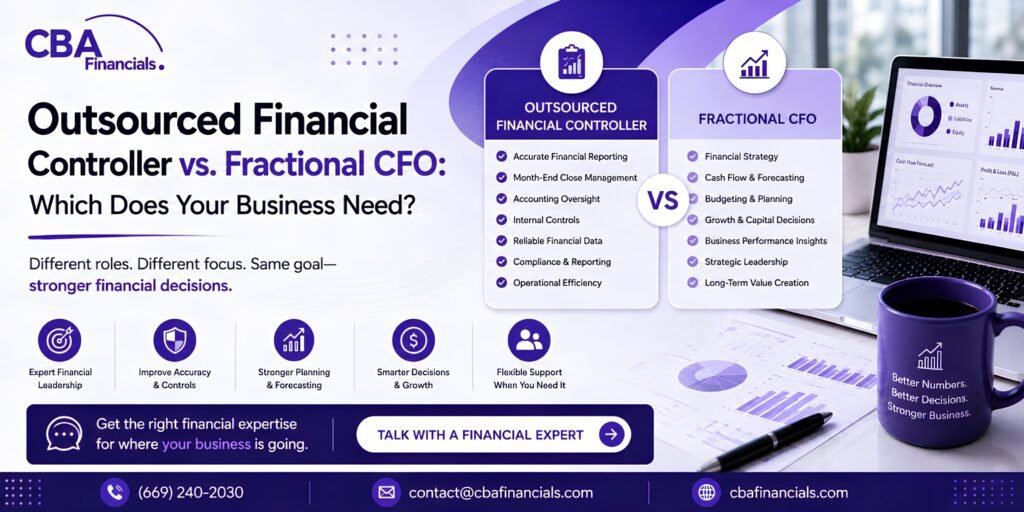
Though these positions can collaborate closely with each other, they are not mutually exclusive. The main function of a financial controller is the proper record keeping and reporting of financial data. The CFO is more interested in the long-term planning and decision making related to the financial matters of the business.
It all depends much less on the size of your company than on what you lack in your current finance operations.
What is an Outsourced Financial Controller?
Outsourced Financial Controller refers to an accounting expert with significant experience who takes charge or is in control of vital activities within the organization’s accounting department without being employed internally.
The task of the outsourced financial controller is to ensure that the organization’s accounting information is accurate, comprehensive, and accessible.
Depending on the engagement, an outsourced controller may handle or oversee:
- Month-end and year-end close
- Account reconciliations
- General ledger review
- Financial statement preparation
- Accounts payable and receivable processes
- Internal accounting procedures
- Budget-to-actual reporting
- Accounting team supervision
- Internal controls
- Audit and lender support
- Accounting system improvements
Put simply, the controller’s job is to answer the following question:
“Are our accounting books accurate, complete, and under control?”
It is particularly critical when a company needs more than mere bookkeeping but does not need a controller on board.
What is a Fractional CFO?
Fractional CFO is a senior-level financial expertise that is offered on an outsourced basis.
While controller is an expert that has more to do with accounting, CFO utilizes financial information in decision-making process for management.
A fractional CFO may help with:
- Financial forecasting
- Cash-flow planning
- Budgeting
- Scenario analysis
- Growth planning
- Pricing decisions
- Capital planning
- Financing decisions
- Investor or lender reporting
- Business performance analysis
- Strategic financial planning
Questions the CFO would be better suited to answer would include:
“What should happen financially to our business, and how do we do that?”
In case you want to open another location, increase your staff size, take a loan, or enter another market, a fractional CFO could model the financial consequences of those decisions.
Outsourced Financial Controller vs Fractional CFO
The easiest way to understand the difference is to look at their primary responsibilities.
| Area | Outsourced financial controller | Fractional CFO |
|---|---|---|
| Main focus | Accounting operations and reporting | Financial strategy and planning |
| Primary question | Are the numbers accurate? | What should we do next? |
| Financial statements | Prepares and reviews | Uses them for analysis |
| Month-end close | Manages or oversees | Usually reviews results |
| Internal controls | Develops and monitors | Helps assess financial risk |
| Cash flow | Reports and monitors | Plans and manages strategically |
| Forecasting | May support | Core responsibility |
| Budgeting | Tracks actual results against budget | Builds and uses financial plans |
| Capital planning | Provides financial information | Evaluates funding options |
| Business decisions | Provides reliable financial data | Advises management on decisions |
| Accounting team | May manage accounting staff | Works with senior finance team |
| Best fit | Financial operations need stronger oversight | Business needs higher-level financial direction |
Neither role is automatically better than the other. They solve different problems.
When Does Your Business Need an Outsourced Financial Controller?
Outsourcing a financial controller can help you overcome challenges that your existing accounting department finds difficult to cope with.
Some common signs include:
Your Financial Reports Are Consistently Late
If the company’s management is only able to review its financial performance weeks after the end of each month, it will be impossible for the company to address any issues promptly.
The role of the controller includes the creation and management of the month-end closing process.
Your Books Need More Than Basic Bookkeeping
The basic bookkeeper can make entries and carry out general accounting work. With the increasing complexity of the business, someone will be required to check the entries, handle the closing process, reconcile discrepancies, and manage the whole accounting process.
This is when controller level assistance comes in handy.
You Are Unsure Whether Your Reports Are Accurate
It is necessary for the financial statements to be reliable so that they can be used for decision-making purposes.
The controller working outside can analyze the reconciliation, balances, journal entries, and accounting processes.
Your Accounting Team Needs Management
If you have bookkeepers or accounting staff but no person in a senior accounting position to supervise them, then outsourcing your controller could provide that supervision for you.
This may take the form of scheduling, reviewing, improving processes, and closing the books monthly.
You Need Better Internal Controls
Whereas the frequency of transactions rises, depending on unofficial systems becomes a burden.
The controller will be able to develop the appropriate procedures, record keeping requirements, and other controls needed in the firm.
When Does Your Business Need a Fractional CFO?
The importance of a Fractional CFO increases where your accounting is pretty good, but you need guidance on what to do next.
Consider a fractional CFO if:
You Are Planning Significant Growth
Increasing revenues do not necessarily equate to being financially ready for business expansion.
The CFO can assist in planning how to hire employees, open branches, purchase equipment, spend on marketing, or any other form of expansion.
Cash Flow Is Becoming Difficult to Predict
It is possible for a growing company to record good sales but suffer from cash shortages.
A fractional CFO can assist in helping the management anticipate cash inflows and outflows, and the funding required in the future.
You Are Considering Financing
If you are preparing for a bank loan or other sources of financing, you will likely need something more than financial statements from the past.
A CFO is able to assist with preparation of forecasts, models, funding needs, etc.
You Are Making Major Decisions Without Financial Modeling
If the decision-making process is more reliant on instincts as a result of a lack of a proper financial model, then CFO involvement might prove beneficial.
This means that prior to employing ten people, it would be wise to know how the payroll will impact your finances for the next year.
You Need a Financial Plan
The CFO is able to relate your business goals to your financial strategy.
This could include your income goals, expense goals, funding needs, budgeting, forecasting, and performance measures.
What If Your Business Needs Both?
Not all growing companies have to make a choice between hiring a controller and a CFO.
Sometimes, they both become necessary.
And here lies an opportunity for collaboration:
Controller → Accurate financial information → CFO → Financial analysis and planning → Business decisions
Controller ensures that management operates with reliable figures.
CFO then utilizes these figures for the assessment of the future of the firm.
For instance, assume your firm plans to expand into another state.
Controller may be able to ensure that there are reliable accounting figures, reports and financial data available.
The CFO will now be able to conduct a cost-benefit analysis and assess costs and benefits associated with expansion.
This approach may prove especially handy as the firm grows in terms of its accounting staff and operations.
What About an Outsourced Financial Controller Service?
Outsourcing financial controller services is where a company gets the expertise of a controller without having a full-time controller on the payroll.
There are many ways of doing this, depending on the company’s needs. Some companies will require the services of a controller on a monthly basis for a specific amount of hours.
A service may include:
- Monthly close management
- Financial statement preparation
- Accounting review
- Reconciliation oversight
- Accounting process improvement
- Internal control development
- Accounting staff supervision
- Financial reporting
- Audit preparation
- Management reporting
How much help is needed will depend on how complex the accounting function within the firm is.
If the accounting needs of the business are fairly simple, then limited assistance per month as a controller might suffice. However, other situations where there would be need for additional assistance include a firm with several entities.
Is Outsourcing Accounting Right for Your Business?
A full-time accountant may not always be feasible for a small business. However, doing everything on your own becomes hard when the business grows.
Outsourcing can give you the ability to get help with accounting without creating an entire accounting department yourself.
It may be a good option for businesses that:
- Need consistent bookkeeping
- Want professional financial reporting
- Are spending too much time on accounting
- Need help preparing for tax season
- Want better cash-flow visibility
- Are experiencing rapid growth
- Need financial support but do not need a full-time accounting employee
This decision is based on several factors such as the size of your organization, the type of services required, and the degree of involvement in accounting activities.
How Financial Controller Outsourcing Fits Into Business Growth
Financial controller outsourcing can bridge the divide between basic bookkeeping and a full internal finance team.
A common pattern might be this one:
Bookkeeper: Deals with daily financial transactions and bookkeeping.
↓
Financial Controller Outsourcing: Responsible for accounting, reporting, closing process, and financial control.
↓
Fractional CFO: Helps with forecasting, financial planning, financing, and strategic decisions.
This is not necessarily a sequential path that every organization will go through. In some cases, an organization may employ one of these individuals but not others, or several people simultaneously.
The key is solving your financial problem, not following a particular path based on the job title of the individual.
Should You Hire a Controller or a Fractional CFO First?
Use this simple test.
Choose an Outsourced Financial Controller if:
- Your books are behind.
- Month-end close takes too long.
- Financial statements are unreliable or incomplete.
- Your accounting team needs supervision.
- Reconciliations are not consistently reviewed.
- Internal accounting procedures need improvement.
- You need stronger financial reporting.
- You are preparing for an audit or lender review.
Choose a Fractional CFO if:
- Your accounting records are already reliable.
- You need financial forecasts.
- Cash flow is difficult to plan.
- You are considering financing.
- You are planning significant expansion.
- You need help evaluating major investments.
- You want better financial planning.
- You need a senior financial advisor but not a full-time CFO.
Consider Both if:
Accounting function requires better control and there is need for assistance in making important financial decisions.
In such a scenario, there must be clear definition of duties of both controller and CFO positions so that they may complement one another.
Don't Hire a CFO to Fix a Controller Problem
One of the worst mistakes an organization could do is to ask its financial strategist to sort out its accounting issues.
The forecasting and advice of the CFOs are based on accurate financial information. In case of unbalanced accounts, late reporting and lack of consistency in the accounting cycle, strategic analysis will become much tougher.
It could also work the other way around.
In case your accounting books are up to date, but there are doubts regarding how much to invest in growth, how to raise finance or how a certain decision would impact the cash flow, then more accounting support won’t help.
The right question is not “Controller or CFO?”
It is:
“What financial problem does my business need to solve right now?”
Final Thoughts
Outsourcing a financial controller vs. fractional CFO
Outsourcing a financial controller provides structure and accountability to the accounting process. It is all about record keeping, reporting, financial control and a consistent close process.
On the other hand, outsourcing a fractional CFO is all about the next step for your business. The main focus of outsourcing the CFO is all about forecasts, cash flow management, financial planning and capital and business strategy decision-making.
Some businesses are ready for controller services at this point in time. Other businesses have an established accounting process and need more strategic financial guidance. Some businesses will find that over time they require both.
CBA Financials assists businesses with evaluating their financial needs and determining how much support they should receive at this particular stage of growth.
Stop digging through spreadsheets for answers you need right now.
